

A training centre for PCO licensing is a specialised venue designed to prepare candidates for the TfL Topographical Assessment by providing expert instruction, standardised resources, and a distraction-free learning environment. The TfL Topographical Assessment is mandatory for all London private hire drivers, and candidates receive only two attempts before their entire TfL application must restart. That two-attempt limit is the single most important reason why a training centre is recommended for PCO preparation. Getting it wrong is not just disappointing. It costs you months of progress and forces you to begin the licensing process from scratch.
The standard industry term for this preparation pathway is “topographical assessment training,” and it covers everything from reading grid references and identifying one-way systems to planning routes through central London. Eltconline, based in Forest Gate, London E7, is a TfL-approved topographical assessment training centre that has helped thousands of candidates pass with confidence.

Why is a training centre recommended for PCO topographical preparation?
Professional training centres produce measurably better outcomes than self-study. Learning effectiveness increases by up to 35% in professional training environments compared to informal methods. That improvement comes from three specific factors: optimised classroom design, technology integration, and instant expert support.
The benefits of training centres for PCO candidates include:
- Distraction-free environment. A dedicated venue removes the interruptions of home or workplace study, which is critical when you are memorising complex London road networks and PHV regulations.
- Standardised, high-specification equipment. Training centres use professional-grade mapping tools and workstations calibrated to mirror actual TfL test conditions. Most candidates are unaware of how different this setup feels compared to a personal laptop at a kitchen table.
- Instant expert support. When you misread a grid reference or struggle with a one-way system near a central reservation, a qualified trainer corrects you immediately. That instant feedback prevents bad habits from forming.
- Improved retention. Adult learning retention increases by 42% in professional training settings due to reduced cognitive load and fewer technical disruptions. Higher retention means you carry more knowledge into the actual assessment.
- Faster path to proficiency. Standardised training conditions reduce time to assessment proficiency by 25–40%. Consistency in the training environment is the most significant factor in reaching that proficiency quickly.
Pro Tip: Book your training sessions at the same time each day. Consistent scheduling conditions your brain to enter a focused learning state at that hour, which mirrors the routine discipline needed on test day.
How does a dedicated training environment improve test day performance?
The physical separation from daily life is a genuine performance advantage, not just a comfort preference. Dedicated training centres eliminate normal workplace interruptions that disrupt the mental concentration required for route planning tasks. When you are working through a complex navigation scenario involving a one-way system, a pedestrian zone, and a grid reference simultaneously, even a brief interruption resets your concentration.
A neutral, dedicated space also fosters academic seriousness. Sitting in a room where everyone around you is preparing for the same assessment creates a shared sense of purpose. That atmosphere is difficult to replicate at home.
The collaborative dimension of centre training adds another layer of value:
- Peer error identification. Peer-to-peer learning helps candidates identify common errors that are invisible during solo study. When a fellow candidate makes a mistake on a route question, you learn from it without having to make it yourself.
- Shared navigation strategies. Cohort members develop shared mental models of London’s road network, which reinforces correct understanding of route planning standards.
- Morale and confidence. Seeing peers progress reassures you that the material is learnable. That reassurance directly reduces test anxiety.
- Immediate support network. Training centres reduce anxiety related to limited assessment attempts by providing a confidence-building support network. Knowing a trainer is present when you struggle changes how you approach difficult material.
“Training centres contribute not just information, but confidence-building essential for high-stakes tests such as the TfL Topographical Assessment.”
That confidence is not a soft benefit. On a test where two failed attempts end your application, arriving at the assessment centre feeling prepared and calm is a concrete advantage.
How do training centres prepare candidates for the TfL assessment format?
The TfL Topographical Assessment has a specific format, and generic geography revision does not address it adequately. Specialist training aligns directly with the test’s structure and pass criteria.
| Preparation method | Alignment with TfL assessment |
|---|---|
| Structured curriculum | Covers TfL-specific route planning, grid references, and road classification standards |
| Professional-grade mapping tools | Calibrated to match actual TfL test conditions, building genuine familiarity |
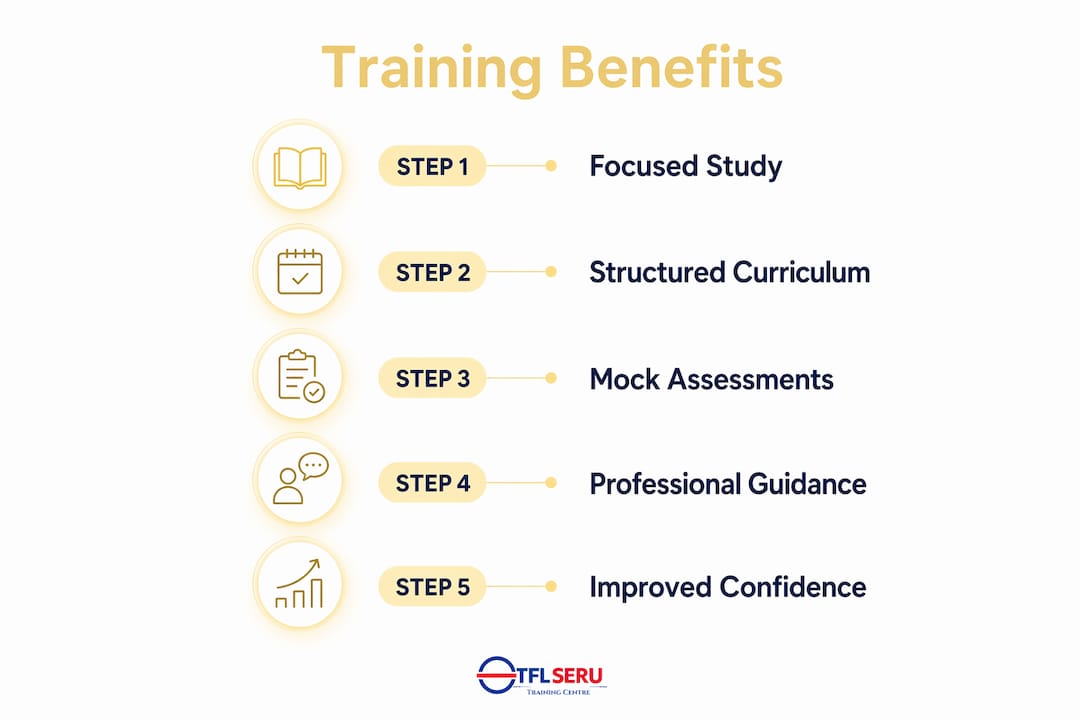
| Mock assessments | Simulate real test scenarios under timed conditions, reducing surprises on the day |
| Targeted feedback | Error correction focused on the specific factors that determine pass or fail |
Mock assessments deserve particular attention. Sitting a full practice paper under timed conditions reveals gaps in your knowledge that revision alone never exposes. You may know every major road in East London but freeze when asked to identify the fastest legal route from Stratford to Canary Wharf under a time constraint. Mock tests surface that gap before it costs you an attempt.
Eltconline’s topographical training programme is structured around TfL’s actual pass criteria. Trainers with direct experience of the assessment design sessions that target the question types and navigation challenges candidates encounter most frequently.
What should candidates look for when choosing a training centre?
Not every training centre delivers the same quality of preparation. Choosing the right one is itself a decision that affects your pass rate.
- TfL approval status. Confirm the centre is an approved TfL topographical assessment training provider. Approval signals that the curriculum and resources meet the regulatory standard.
- Trainer qualifications. Ask specifically about your trainers’ experience with TfL topographical assessments. General driving instructors and specialist topographical trainers are not the same.
- Location and scheduling. A centre you can reach easily and attend consistently is more valuable than a prestigious one you skip sessions at. Eltconline’s Forest Gate location in London E7 is well-connected by public transport.
- Available resources. Professional-grade mapping tools, printed route materials, and access to study techniques aligned with TfL requirements all matter. Ask what materials you receive as part of the course.
- Mock test provision. A centre that offers mock assessments under realistic conditions is significantly more valuable than one that only covers theory.
- Cost versus value. The fee for professional training is modest compared to the cost of restarting a TfL application after two failed attempts. Evaluate cost in that context, not in isolation.
Pro Tip: Ask the centre for its pass rate data before enrolling. A credible centre tracks candidate outcomes and will share that information openly. Vague answers about “high success rates” without figures are a warning sign.
The importance of training centres becomes clearest when you consider the alternative. Self-study using free online maps and unofficial guides leaves you without feedback, without mock test conditions, and without the confidence that comes from practising alongside qualified trainers.
Key takeaways
A training centre is the most reliable preparation route for the TfL Topographical Assessment because it combines standardised conditions, expert feedback, and peer learning in a way that self-study cannot replicate.
| Point | Details |
|---|---|
| Two-attempt limit makes preparation critical | Failing both TfL assessment attempts restarts your entire PCO application, so professional preparation is not optional. |
| Retention improves significantly in centres | Adult learning retention increases by 42% in professional training settings compared to informal study methods. |
| Standardised conditions accelerate proficiency | Consistent equipment and environment reduce time to assessment readiness by 25–40%. |
| Mock tests reveal hidden knowledge gaps | Timed practice papers expose weaknesses that standard revision never surfaces before the real assessment. |
| Trainer qualifications and TfL approval matter | Choose a centre with verified TfL approval and trainers experienced specifically in topographical assessments. |
The case for professional preparation: a perspective from experience
Candidates who attempt the TfL Topographical Assessment after self-study alone tend to underestimate one specific problem: they do not know what they do not know. Revising from maps at home feels productive. You cover the material, you feel familiar with the roads, and you arrive at the test centre with reasonable confidence. Then the question format, the time pressure, and the specific phrasing of route planning tasks catch you off guard.
The psychological dimension of the two-attempt rule is something I have seen affect candidates repeatedly. The awareness that a second failure ends the application creates a pressure that self-study does not prepare you for. A training centre addresses that pressure directly. Sitting mock assessments in a professional environment, receiving immediate feedback, and watching your accuracy improve session by session builds a specific kind of confidence that reading alone cannot produce.
The candidates who pass on their first attempt are not always the ones who studied the most hours. They are the ones who studied in the right conditions, with the right feedback, and with a clear understanding of what the assessment actually tests. That is what a quality training centre provides.
Investing in professional preparation is not a luxury for serious PCO candidates. It is the most rational decision you can make given the stakes involved.
— East
Eltconline: specialist TfL topographical training in East London
Eltconline is a TfL-approved topographical assessment training centre based in Forest Gate, London E7, with a track record of helping thousands of candidates pass their test with confidence.
The training programme at Eltconline is built around TfL’s actual assessment format, with structured sessions, professional-grade mapping resources, and qualified trainers who specialise in topographical preparation. Candidates can also book a TfL topographical mock test to experience realistic test conditions before the real assessment. For candidates ready to begin, the full topographical training programme covers everything from grid references to route planning under timed conditions. With only two attempts permitted, preparing with a specialist centre is the clearest path to passing first time.
FAQ
What is the TfL Topographical Assessment for PCO licensing?
The TfL Topographical Assessment is a mandatory test for all London private hire vehicle drivers, evaluating knowledge of London’s road network, grid references, and route planning. Candidates receive only two attempts before their TfL application must restart.
Why is a training centre recommended over self-study for the PCO test?
Professional training environments increase learning effectiveness by up to 35% and improve adult retention by 42% compared to informal methods. Centres also provide mock assessments, expert feedback, and standardised equipment that self-study cannot replicate.
How many attempts do candidates get at the TfL Topographical Assessment?
Candidates receive two attempts at the TfL Topographical Assessment. Failing both means restarting the entire PCO licensing application, which makes thorough preparation at a specialist centre the most sensible approach.
What should I look for in a PCO topographical training centre?
Confirm the centre holds TfL approval, employs trainers with specific topographical assessment experience, and offers mock tests under timed conditions. Location accessibility and clear pass rate data are also reliable indicators of a credible provider.
Does Eltconline offer mock tests for the TfL Topographical Assessment?
Yes. Eltconline offers mock test sessions designed to simulate the actual TfL assessment, helping candidates build familiarity with the format and identify knowledge gaps before their official attempt.
Recommended
- East London PCO Training Centre
- PCO Training in London | TFL Topographical & SERU Training
- London PCO Training
- Apply for PCO Licence
