

Topographical test study techniques are the scientifically proven methods that help you learn, retain, and apply London street knowledge under the pressure of the TfL Topographical Assessment. This assessment, formally known as the TfL Topographical Skills Test, is a requirement for every private hire vehicle (PHV) licence applicant in London. You only get two attempts before your entire TfL application resets, which makes preparation non-negotiable. The right approach combines active recall, spaced repetition, and timed mock practice with physical tools like the London A–Z map and digital platforms for route-based retrieval.
Which study techniques scientifically boost topographical test performance?

Practice testing and distributed practice are rated as the two highest-utility study methods in cognitive science research. This means that how you study matters far more than how long you study. For the TfL Topographical Assessment, this distinction is critical.
Here are the core techniques that deliver results:
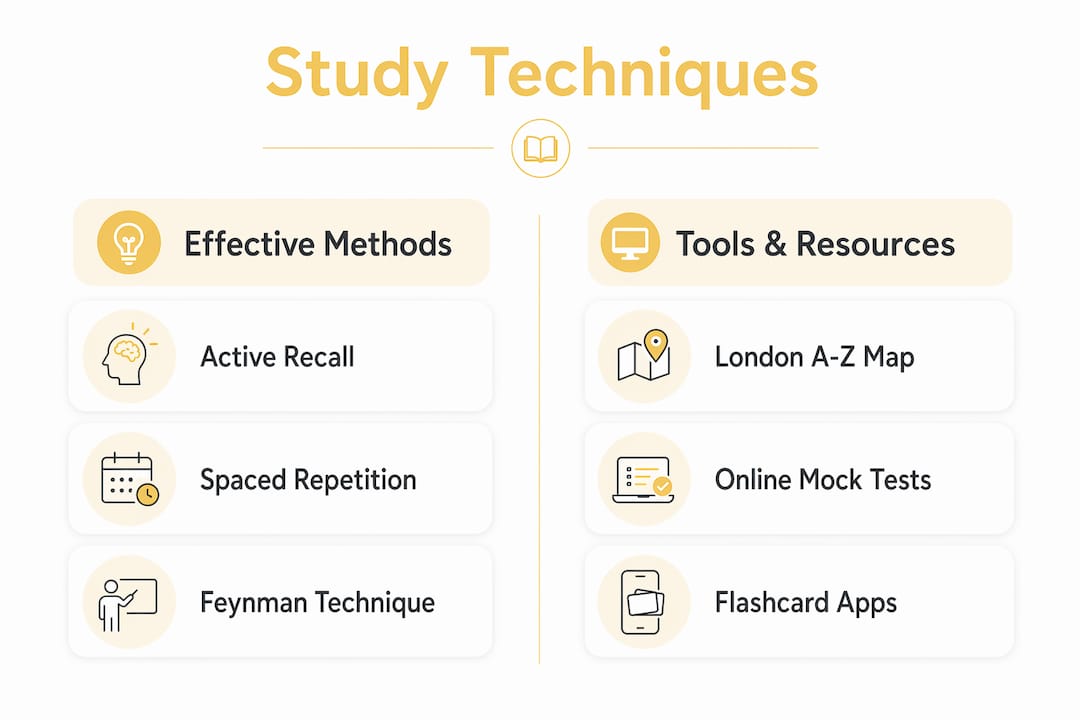
- Active recall. Rather than rereading a route, close the map and attempt to draw it from memory. The University of Queensland recommends one-page summaries and drawing from memory as the most effective methods for geography learning. The act of retrieving information, not reviewing it, builds the neural pathways you need on test day.
- Spaced repetition. Review material at increasing intervals rather than in one long session. A structured schedule of 1 hour, 1 day, 3 days, 7 days, 21 days, and 60 days after initial study gives your memory time to consolidate each route and grid reference before the next review.
- Practice testing. Sit timed mock exams that replicate the actual test format. This trains both your knowledge and your ability to work under time pressure, which is a separate skill from map reading itself.
- Interleaving. Mix different areas of London within a single study session rather than studying one borough exhaustively before moving to the next. This forces your brain to distinguish between similar routes and builds flexible thinking.
- The Feynman technique. Explain a route or junction aloud as if teaching someone with no knowledge of London. The Feynman technique accelerates understanding by exposing gaps you did not know existed. If you cannot explain why a route uses a particular one-way system, you have identified a revision target.
Pro Tip: Combine active recall with the Feynman technique by drawing a route from memory and then narrating it aloud. This dual-channel approach forces both spatial and verbal retrieval simultaneously, which deepens retention far more than either method alone.
What resources and tools do you need for TfL test preparation?
The right tools reduce wasted study time and keep your preparation focused on what the TfL Topographical Assessment actually tests. You need a combination of physical and digital resources working together.
Physical resources:
- London A–Z map (current edition). This is your primary study document. Use it to trace routes, identify grid references, and practise locating landmarks such as hospitals, railway stations, and major junctions.
- Printed route sheets. Write out routes by hand from memory, then check against the A–Z. Map drawing practice and timed tests are consistently cited as the most effective preparation steps for TfL candidates.
- A dedicated error log notebook. Record every route or question you get wrong, along with the correct answer. This becomes your most targeted revision resource as the test date approaches.
Digital resources:
- Online mock tests that replicate the TfL format. These allow you to practise under timed conditions from home, which is essential for building test-day composure.
- Anki, a free spaced repetition flashcard application. You can create cards for individual junctions, one-way streets, and grid references, then let the algorithm schedule your reviews automatically.
- A digital study planner or calendar to map out your preparation weeks in advance.
| Resource | Pros | Cons |
|---|---|---|
| London A–Z map (physical) | Accurate, portable, no screen fatigue | Cannot simulate timed test conditions |
| Anki flashcard app | Automates spaced repetition scheduling | Requires time to set up cards initially |
| Online mock tests | Replicates real test format and timing | Requires internet access |
| Printed route sheets | Builds handwriting and spatial memory | No instant feedback on errors |
Practising from home with a combination of these tools gives you the flexibility to study around work and family commitments without sacrificing quality.
How to structure your study sessions for maximum results
Structure is what separates candidates who pass on their first attempt from those who run out of attempts. Realistic scheduling that accounts for transport, sleep, and family commitments consistently produces better exam outcomes than marathon study blocks.
Follow this step-by-step weekly planning framework:
- Assess your starting point. Before you plan anything, sit a diagnostic mock test to identify which areas of London you know well and which you do not. This prevents you from spending equal time on strengths and weaknesses.
- Divide London into zones. Group your study by area: Central London, North, South, East, and West. Assign one zone per week for initial learning, then rotate back through all zones using spaced repetition intervals.
- Plan micro-sessions, not marathons. Study in focused blocks of 25 to 40 minutes with a 10-minute break. Short micro-study sessions ease working memory and reduce the mental fatigue that causes errors on test day.
- Schedule your spaced repetition reviews. After your first study of a route or area, mark your calendar for reviews at 1 day, 3 days, 7 days, and 21 days. Use Anki to automate this for individual facts and your notebook for full route reviews.
- Add a weekly mock test. Every weekend, sit a full timed mock exam under realistic conditions. Review every error immediately afterwards and add incorrect items to your error log for the following week’s retrieval practice.
- Build in rest. Sleep is not optional in a study plan. Memory consolidation happens during sleep, so a consistent 7 to 8 hours per night is a direct investment in your retention.
Pro Tip: Place your error log review as the first task of every study session, not the last. Starting with your weakest material, when your focus is sharpest, accelerates improvement faster than saving it for the end when fatigue has set in.
What are common mistakes when studying for the topographical test?
Most candidates study hard but study inefficiently. Recognising these pitfalls early saves you weeks of wasted effort.
- Passive rereading and highlighting. Highlighting and rereading build familiarity, not recall. Familiarity feels like learning but fails under test conditions because it does not train retrieval. Replace both habits with active recall immediately.
- Cramming large blocks of content. Studying for five hours the night before a mock test does not substitute for weeks of distributed practice. The spaced repetition schedule exists precisely because massed study produces short-term retention that collapses under pressure.
- Ignoring timed practice. Many candidates study routes thoroughly but have never practised answering questions within a 1 to 2 minute window. Time management is a separate skill that requires deliberate training.
- Skipping route drawing. Reading a route on a map and drawing it from memory are entirely different cognitive tasks. If you are not regularly drawing routes without looking at the A–Z, you are not preparing for what the test actually demands.
- Failing to review errors systematically. Error logs from practice tests focus revision on weak spots and enhance long-term retention. Without an error log, you will repeat the same mistakes across multiple mock tests without improvement.
Candidates who treat every wrong answer as a revision item, rather than a disappointment, consistently outperform those who focus only on what they already know.
How do you apply these techniques directly to TfL assessment practice?
Theory becomes performance only when you apply it to the specific format of the TfL Topographical Assessment. Here is how to translate each technique into direct test preparation:
- Learn the question format first. The TfL Topographical Assessment uses multiple-choice questions that require you to identify correct routes, select appropriate junctions, and interpret map-based scenarios. Knowing the format means you are never surprised by the structure on test day.
- Practise drawing routes on the A–Z from memory. Choose a start point and destination, close the map, and draw the route on a blank sheet. Then open the A–Z and check every turn. This retrieval workflow, drawing from memory followed by immediate self-checking, is one of the most effective methods for topographical learning.
- Train for 1 to 2 minutes per question. The University of Sydney advises detailed knowledge of exam format and timed practice as the foundation of multiple-choice efficiency. Set a timer for each question during mock tests and stop when it sounds, even if you have not answered. This builds the discipline to commit to an answer rather than second-guessing.
- Combine mock tests with error analysis. After every timed mock, open your error log and record each incorrect answer with the correct route or grid reference. During your next study session, retrieve those items first using active recall before reviewing any new material.
- Use the Feynman technique on difficult routes. For any route you get wrong more than once, explain it aloud from memory, including street names, turns, and any one-way restrictions. If you stumble, you have found the exact gap to address. High-scoring geography answers link examples to broader processes rather than relying on rote memorisation, and the same principle applies to topographical route knowledge.
Key takeaways
Passing the TfL Topographical Assessment requires active recall, spaced repetition, and timed mock practice applied consistently over weeks, not days.
| Point | Details |
|---|---|
| Active recall beats rereading | Draw routes from memory and use the Feynman technique rather than passively reviewing maps. |
| Spaced repetition prevents forgetting | Review material at intervals of 1 day, 3 days, 7 days, and 21 days after first study. |
| Timed mock tests are non-negotiable | Practise answering within 1 to 2 minutes per question to build the speed the test demands. |
| Error logs accelerate improvement | Record every wrong answer and retrieve those items first in your next session. |
| Realistic scheduling protects performance | Plan study around sleep, family, and transport to maintain consistency without burnout. |
What I have learned from watching candidates prepare for the topographical test
Most candidates who struggle with the TfL Topographical Assessment are not short on effort. They are short on method. I have seen dedicated people spend weeks with the A–Z map and still underperform because they were reviewing routes rather than retrieving them. The shift from passive review to active retrieval is the single biggest change you can make, and it costs nothing except the discomfort of not knowing the answer immediately.
The candidates who pass confidently tend to share one habit: they treat wrong answers as data, not failure. An error log is not a record of inadequacy. It is a precision revision tool. When you combine that habit with a spaced repetition schedule and weekly timed mocks, you are not just preparing for a test. You are building genuine knowledge of London that will serve you throughout your career as a PHV driver.
One thing I would add that most guides overlook: protect your sleep in the final two weeks before the assessment. Fatigue does not just slow you down. It specifically impairs the spatial memory and route recall that the topographical test depends on. A well-rested candidate with 80% of the content covered will outperform an exhausted candidate with 100% of the content reviewed.
— East
Start your preparation with structured topographical training
Knowing which techniques to use is the first step. Having the right practice environment makes the difference between theory and a pass certificate.
Eltconline, based in Forest Gate, London E7, is an approved TfL Topographical Assessment training centre that has helped thousands of candidates pass with confidence. You can sit a TfL topographical mock test online to benchmark your current knowledge and identify exactly where to focus your revision. For candidates who want structured guidance from experienced tutors, Eltconline’s topographical training programme covers map reading, route planning, and test strategies in depth. You can also practise from home using Eltconline’s digital tools at a pace that fits your schedule. Register early and give yourself the preparation time your licence application deserves.
FAQ
What are the most effective topographical test study techniques?
Active recall and spaced repetition are the two highest-utility methods for the TfL Topographical Assessment. Drawing routes from memory, sitting timed mock tests, and reviewing errors systematically produce the strongest results.
How long should I study for the TfL Topographical Assessment?
Most candidates benefit from six to eight weeks of structured preparation using daily micro-sessions of 25 to 40 minutes. Distributed practice over several weeks outperforms intensive cramming in the days before the test.
Can I practise for the topographical test at home?
Yes. Online mock tests, Anki flashcard apps, and printed route drawing exercises all support effective home study. Eltconline offers dedicated online practice tools designed specifically for TfL candidates.
What happens if I fail the TfL Topographical Assessment?
You are permitted two attempts at the TfL Topographical Assessment. If you fail both, your TfL application resets entirely. This makes thorough preparation before your first attempt the most important investment you can make.
Is the Feynman technique useful for topographical study?
Yes. Explaining a route or junction aloud in plain language forces you to identify gaps in your knowledge that passive review misses. It is particularly effective for complex one-way systems and multi-junction routes.
Recommended
- Topographical Test Training | Get quality training | ELTC
- Tfl topographical test, practice from home |ELTC
- Need topographical training | Topographical specialists
Article generated by BabyLoveGrowth
