

A PHV licence authorises your vehicle for private hire use, while a PCO licence is the legal permission that allows you, as the driver, to carry paying passengers on pre-booked journeys in London. These are two separate licences, issued for two separate purposes, and both are required before you can legally operate as a private hire driver. The difference between PHV and PCO licence is one of the most misunderstood distinctions in London’s private hire sector, and getting it wrong can cost you time, money, and your ability to work. This article explains both licences clearly, compares their requirements, and guides you through obtaining them efficiently.
What is the difference between a PHV and PCO licence?
The PHV licence and the PCO licence serve entirely different functions, even though both are required for the same job. A PHV (Private Hire Vehicle) licence is attached to the car or minivan you drive. A PCO (Private Carriage Office) licence, now formally issued by Transport for London (TfL), is attached to you as the driver. Confusion between the two is common because people often use “PCO licence” as a catch-all term for the whole licensing process, when in reality it refers specifically to the driver’s authorisation.
The term “PCO” originates from the Public Carriage Office, the body that historically regulated London’s taxis and private hire vehicles before TfL absorbed its functions. Today, TfL issues both licences, but they remain legally distinct. One covers the vehicle; the other covers the person behind the wheel. Neither licence alone is sufficient for legal private hire work in London.

What exactly is a PHV licence and what does it cover?
A PHV licence is issued to a specific vehicle and confirms that it meets TfL’s safety and compliance standards for private hire use. The vehicle must seat no more than eight passengers, pass a TfL-approved inspection, and carry appropriate insurance that matches its intended use as a private hire vehicle.
Key facts about the PHV vehicle licence:
- The vehicle must pass a TfL-approved mechanical inspection before the licence is granted.
- PHV-licensed vehicles can only be used for pre-booked journeys arranged through a licensed operator or platform such as Uber, Bolt, or Addison Lee.
- Street hailing is strictly prohibited. A PHV driver cannot legally pick up a passenger who flags them down on the street.
- The PHV licence is tied to the vehicle, not the driver. If you change vehicles, you need a new PHV licence for the replacement car.
- Licence validity periods and renewal fees differ from those of the driver’s PCO licence, so renewal dates will not always align.
A common misconception is that a PHV licence grants you permission to drive for hire. It does not. It simply confirms the vehicle is fit and authorised for that purpose. Without a valid PCO driver’s licence, the vehicle licence is irrelevant for earning purposes.
Pro Tip: When purchasing a vehicle for private hire work, confirm it meets TfL’s age and emission standards before applying for the PHV licence. Buying a non-compliant vehicle and then discovering it fails inspection wastes both time and money.
What is a PCO licence and what requirements must drivers meet?
A PCO licence is the driver’s licence issued by TfL that grants legal permission to carry fare-paying passengers on pre-booked private hire journeys. It is the more demanding of the two licences to obtain, and the application process typically takes between 8 and 16 weeks depending on how quickly you complete each stage. That timeline reflects the deliberate thoroughness TfL builds into the process to uphold safety and professionalism across London’s private hire network.
To be eligible, you must meet the following criteria:
- Age and driving experience. You must be at least 21 years old and hold a full UK or EU driving licence with a minimum of three years’ experience.
- Right to work in the UK. TfL verifies your immigration status as part of the application.
- Medical assessment. You must pass a DVLA Group 2 medical standard examination, which is more rigorous than a standard driving medical.
- Enhanced DBS check. A Disclosure and Barring Service check at the enhanced level is mandatory to confirm your criminal record status.
- SERU assessment. The Safeguarding and Equality Requirements for Uber and other operators test is TfL’s knowledge assessment covering regulations, equality, and passenger safety. SERU and English tests measure not just knowledge but communication skills and regulatory understanding essential for safe operation.
- English language test. You must demonstrate sufficient written and spoken English to communicate clearly with passengers and operators.
- Topographical skills assessment. This test evaluates your ability to read maps, plan routes, and navigate London using grid references and street-level knowledge. You only receive two attempts at the TfL Topographical Assessment before your entire application must restart, making thorough preparation non-negotiable.
- HMRC check. TfL confirms your tax compliance status with HMRC before granting the licence.
Pro Tip: Book your topographical skills assessment only after completing a structured training course. With just two attempts permitted before your application resets, treating this test as something you can pass on instinct alone is a serious mistake.
The PCO licence is valid for three years and must be renewed before expiry. Letting it lapse means you cannot legally carry passengers, even if your PHV vehicle licence remains active.
How do PHV and PCO licences differ and why does the distinction matter?
The table below captures the core differences between the two licences at a glance.
| Feature | PHV vehicle licence | PCO driver’s licence |
|---|---|---|
| What it covers | The vehicle | The driver |
| Issued by | Transport for London (TfL) | Transport for London (TfL) |
| Validity period | Typically 1 year | 3 years |
| Key requirement | Vehicle inspection and insurance | Medical, DBS, SERU, topographical test |
| Can you work with only this? | No | No |
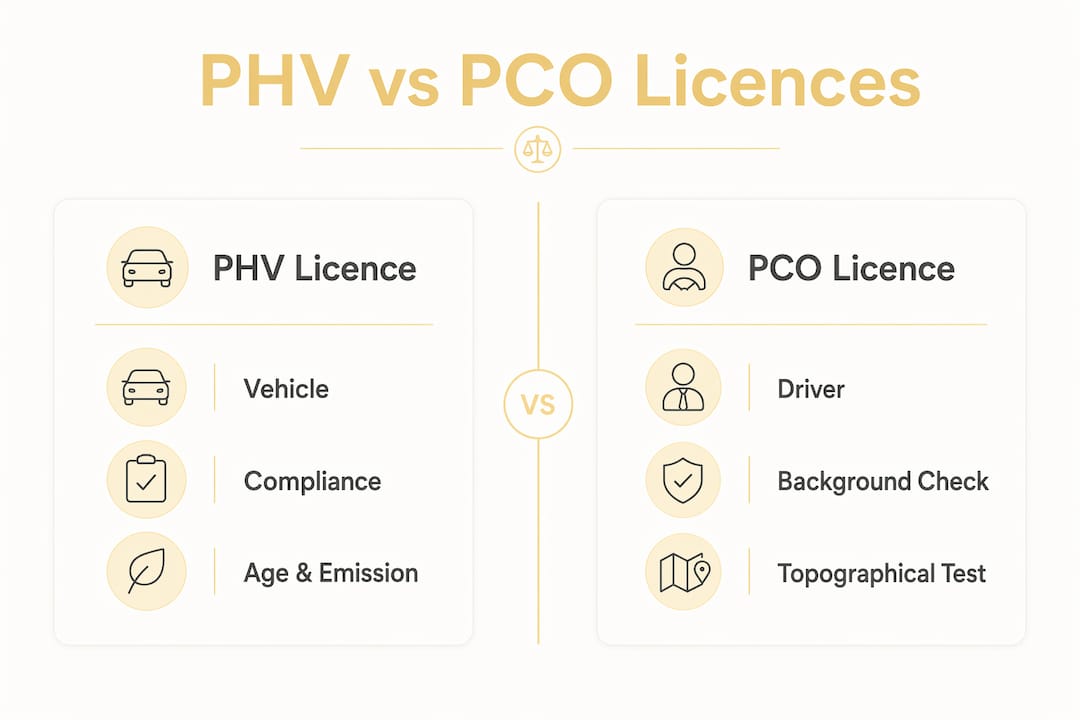
Both licences must be active simultaneously for legal operation. Holding only one is insufficient and leaves you exposed to prosecution, fines, and loss of income. This is the critical point that many prospective drivers overlook when they first research the PHV licensing process.
The distinction also matters when working with operators. Uber, Bolt, and Addison Lee each require you to present both a valid PCO driver’s licence and a PHV vehicle licence before activating your account. If either lapses, your account is suspended immediately. Any lapse in either licence immediately suspends your legal ability to work, with no grace period.
Understanding the PHV vs PCO licence difference also clarifies why private hire drivers cannot operate like black cab drivers. Hackney carriage (black cab) drivers hold a different licence category that permits street hailing and use of taxi ranks. PHV drivers are restricted to pre-booked journeys only, arranged through a licensed operator. This is not a minor operational detail. It is a legal boundary with real enforcement consequences.
What are the steps to obtain both licences efficiently?
The most effective approach is to treat the PCO driver’s licence and the PHV vehicle licence as parallel workstreams rather than sequential tasks. Applying for both simultaneously prevents the common situation where a driver passes all their assessments but then waits weeks for the vehicle inspection, delaying their first paid job.
Follow this sequence to manage both applications without unnecessary delays:
- Confirm vehicle eligibility. Check TfL’s current age, emission, and specification requirements for your intended vehicle before purchasing or committing to it.
- Book your medical assessment. This is often the longest-lead item. Book it as early as possible since some clinics have waiting times of several weeks.
- Begin SERU and English language preparation. Both tests require dedicated study. Use practice materials and, where possible, a structured course to prepare.
- Prepare for the topographical skills test. Enrol in a TfL-approved topographical training course well in advance. Given the two-attempt limit, preparation is not optional.
- Submit your PCO driver’s licence application to TfL. Include all required documents: proof of identity, right to work, DVLA licence, medical certificate, and DBS certificate.
- Book your vehicle inspection. Submit the PHV vehicle licence application alongside proof of insurance and the vehicle’s compliance documentation.
- Synchronise your renewal dates. Once both licences are granted, note their expiry dates and set reminders well in advance to avoid accidental lapses.
Pro Tip: Budget carefully before you begin. PCO licence fees, medical costs, DBS checks, test fees, and vehicle inspection charges can total several hundred pounds. Having funds ready avoids delays caused by deferred payments.
The full process from first application to holding both active licences typically takes two to four months for well-prepared candidates. Candidates who underestimate the topographical or SERU assessments often extend that timeline significantly.
How do PHV and PCO licences affect your daily work as a driver?
Once you hold both licences, they shape every aspect of how you operate legally in London. The key operational realities are:
- No street hailing. You cannot accept a passenger who approaches your vehicle on the street. Every job must be pre-booked through a licensed operator.
- Operator dependency. Your income depends entirely on working through a TfL-licensed operator. Uber, Bolt, and Addison Lee are the largest platforms, but smaller local operators also hold operator licences.
- Cross-border rules. Your TfL-issued licences are valid in London. If you wish to operate in another local authority area, that council’s licensing rules apply separately.
- Insurance compliance. Your vehicle insurance must specifically cover private hire use. Standard personal or business car insurance is not sufficient and will invalidate your PHV licence.
- Incident reporting. Both licences carry reporting obligations. You must notify TfL of any relevant criminal convictions, medical changes, or accidents within a specified timeframe.
- Vehicle and driver compliance must align with operator licensing. Your driver and vehicle licences must be issued by the same licensing authority as your operator.
Keeping both licences current is not just a legal formality. It is the foundation of your earning ability. A lapsed licence means zero income until it is reinstated.
Key takeaways
A PHV licence covers the vehicle, and a PCO licence covers the driver. Both are mandatory, issued separately by TfL, and must remain active simultaneously for legal private hire work in London.
| Point | Details |
|---|---|
| PHV licence covers the vehicle | It confirms the car meets TfL safety and compliance standards for private hire use. |
| PCO licence covers the driver | It grants legal permission to carry fare-paying passengers on pre-booked journeys. |
| Both licences are mandatory | Holding only one is insufficient; you cannot legally operate without both active. |
| PCO process takes 8 to 16 weeks | Multiple assessments including medical, DBS, SERU, English, and topographical tests are required. |
| Parallel applications save time | Applying for both licences simultaneously avoids delays and gets you working sooner. |
Why most candidates get this wrong before they even apply
The most persistent mistake I see prospective drivers make is treating the PCO licence as a single hurdle rather than a multi-stage process with real consequences for failure at any point. The topographical skills test is the clearest example. Candidates arrive having glanced at a few London maps, confident their general knowledge will carry them through. Two failed attempts later, their entire TfL application resets and they lose months of progress.
The PHV side is equally underestimated. Drivers focus entirely on passing their assessments while the vehicle sits uninspected and uninsured for private hire use. When the PCO licence finally arrives, the vehicle is not ready, and the driver cannot work. This is a preventable delay that proper planning eliminates entirely.
What I find genuinely encouraging is how quickly well-prepared candidates move through the process. Those who complete structured topographical training, study the SERU material seriously, and book their medical early consistently reach the finish line within the expected 8 to 16 week window. The process is demanding by design, as the PCO process is deliberately comprehensive to protect passengers and maintain professional standards. Respecting that rigour, rather than trying to shortcut it, is the most reliable path to holding both licences and starting work with confidence.
— East
Start your PCO licence journey with the right preparation
If you are ready to begin the process of becoming a licensed private hire driver in London, preparation for the topographical skills test is one of the most important steps you can take right now.

At Eltconline, we specialise in TfL topographical assessment training from our centre in Forest Gate, London E7. Our courses are designed specifically for PCO licence applicants, with structured lessons, mock tests, and expert guidance from tutors who understand exactly what TfL assessors look for. Thousands of candidates have passed their topographical test with our support. With only two attempts permitted before your application resets, the stakes are too high to leave this to chance. Explore our PCO licence training courses and our dedicated topographical skills preparation to give yourself the strongest possible start.
FAQ
What is the main difference between a PHV and PCO licence?
A PHV licence authorises a specific vehicle for private hire use, while a PCO licence is the driver’s legal permission to carry paying passengers on pre-booked journeys. Both are issued by TfL and both must be held simultaneously to operate legally.
Can I work as a private hire driver with only a PCO licence?
No. You also need a valid PHV vehicle licence for the car you intend to drive. Without both licences active at the same time, you cannot legally carry passengers for payment in London.
How long does it take to get a PCO licence in London?
The PCO application process typically takes between 8 and 16 weeks, depending on how quickly you complete the medical, DBS, SERU, English language, and topographical assessments.
How many attempts do I get at the TfL topographical test?
You receive two attempts at the TfL Topographical Assessment. If you fail both, your entire TfL application must restart from the beginning, making thorough preparation with a qualified training centre strongly advisable.
Do PHV and PCO licences need to be renewed at the same time?
No. The PHV vehicle licence is typically renewed annually, while the PCO driver’s licence is valid for three years. You need to track both renewal dates separately to avoid any lapse in either licence.
Recommended
- Apply for PCO Licence
- London PCO Licence Application
- London PCO Licence – Apply & Pass London PCO Licence exams
- TFL PCO Licence Renewal Process for Private Hire Drivers | ELTC
Article generated by BabyLoveGrowth

Pingback: TfL application process explained: 2026 guide
Pingback: Why background check PCO licence: your 2026 guide
Pingback: PCO photo ID requirements explained for London applicants