

The TfL application process for a private hire driver (PHV) licence is a structured, multi-stage sequence requiring you to complete an online application, pass three mandatory assessments, submit specific documents, and pay updated 2026 fees. Transport for London (TfL) administers this process under its Taxi and Private Hire licensing framework, and the licence is formally known as a PHV driver licence, though many applicants refer to it as a PCO licence. Understanding each stage before you begin is the single most effective way to avoid costly delays and failed attempts.
What does the TfL application process involve?
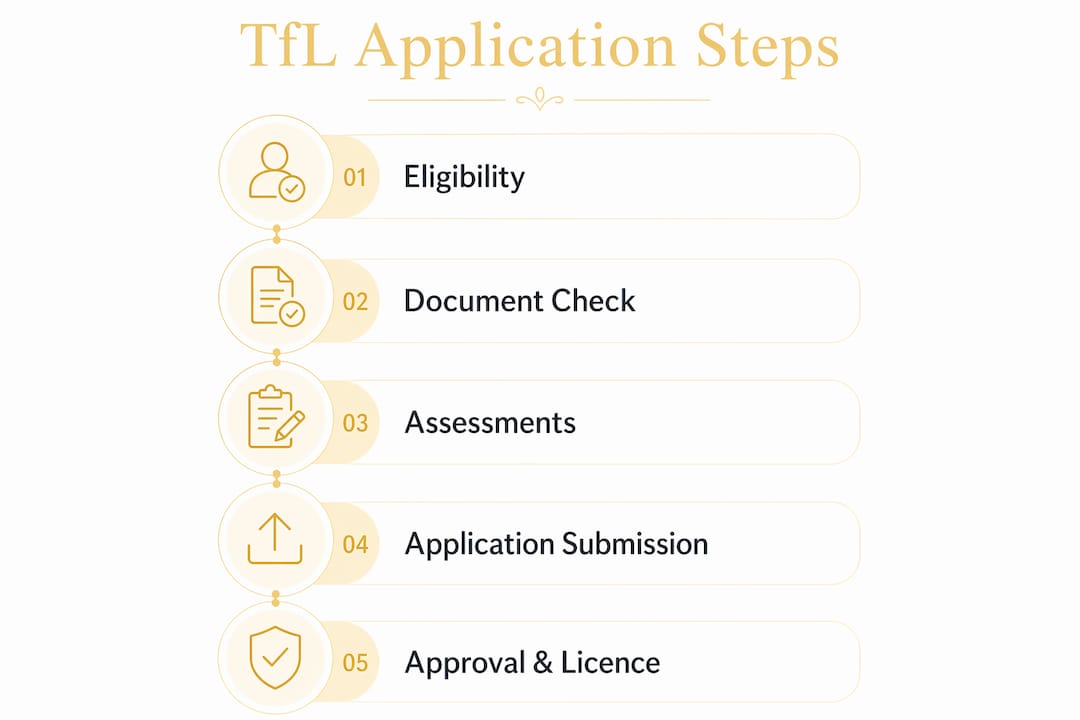
The TfL application process for a private hire driver licence consists of five core stages: eligibility check, document preparation, assessment completion, application submission, and licence activation. Each stage must be completed in the correct order, and skipping or rushing any one of them is the most common reason applications stall. TfL processes first-time applicants within 10 working days when all documents and tests are submitted correctly, but that timeline depends entirely on you getting everything right from the start.
The three mandatory assessments are the SERU (Safety, Equality and Regulatory Understanding) test, the English speaking and listening test, and the topographical skills assessment. All three must be passed before your application can progress. The 2026 fee updates have also changed the financial picture, so budgeting accurately before you begin is worth doing now rather than later.

What documents and eligibility requirements do you need?
TfL requires a specific set of documents before it will accept your application for processing. Missing even one item results in refusal or, worse, revocation of a licence already granted if misinformation is later discovered. Here is what you need to prepare:
- Application form MHC/203 or PHV/203, fully and accurately completed. Incomplete or incorrect forms result in automatic refusal.
- Current UK or EEA driving licence, held for a minimum of three years.
- Enhanced DBS check, obtained through TfL’s approved process. This check is mandatory and typically costs around £80 when arranged through a qualified provider.
- Medical examination meeting DVLA Group 2 standard, completed by a registered GP or occupational health professional.
- Proof of right to work in the UK, such as a passport, biometric residence permit, or share code.
- English language evidence, unless you qualify for an exemption (covered in the next section).
One area where applicants frequently stumble is the medical examination. DVLA Group 2 standard is more stringent than a standard driving medical. It assesses vision, cardiovascular health, and neurological fitness. Book this appointment early because GP availability can add weeks to your timeline.
Pro Tip: Scan and save digital copies of every document before submission. TfL may request additional evidence at any point, and having everything organised in one folder saves significant time.
You can find a detailed breakdown of the London PCO licence application requirements on the Eltconline website, which is particularly useful if you are applying for the first time.
Which assessments must you pass and how do you prepare?
Three assessments stand between you and your PHV licence. Each tests a different competency, and each carries its own fee under the 2026 structure.
The three required assessments
| Assessment | 2026 first attempt fee | Re-sit fee |
|---|---|---|
| SERU (Safety, Equality and Regulatory Understanding) | £40 | £30 |
| English speaking and listening | £40 | £30 |
| Topographical skills assessment | £40 | £30 |
The application fee itself is £138, bringing your minimum total outlay to £258 before medical and DBS costs. Plan your budget around this figure from the outset.
The SERU test covers TfL regulations, passenger safety, equality law, and driver conduct. It is a multiple-choice assessment, and TfL provides an official study guide. Most applicants who fail do so because they underestimate the regulatory detail required.
The English speaking and listening test assesses your ability to communicate clearly with passengers. Applicants holding UK academic qualifications such as GCSEs in English are exempt from this requirement. TfL publishes a full list of acceptable qualifications on its website. If you are unsure whether you qualify for an exemption, check before booking the test to avoid paying an unnecessary fee.
The topographical skills assessment is the test most applicants find most challenging. It tests your ability to navigate London using A-Z maps and plan routes of varying length and complexity. You will be asked to identify streets, grid references, landmarks, and plan efficient routes between locations. Failing to practise A-Z map reading is the leading cause of test failure, and this is the one assessment where structured preparation makes a measurable difference.
A critical point: you only get two attempts at the topographical assessment before you must restart your entire TfL application. That makes preparation non-negotiable, not optional.
Here is a practical preparation sequence for the topographical test:
- Obtain a current London A-Z street atlas and study the grid reference system.
- Practise identifying major roads, one-way systems, and key landmarks across all London boroughs.
- Work through timed route-planning exercises, including routes that cross central London.
- Sit at least one mock test under exam conditions before your actual booking.
- Review any weak areas identified in mock tests and repeat until confident.
Pro Tip: Book all three assessments as early as possible. TfL processes applications based on completeness and order received, so early assessment booking directly reduces your overall waiting time.
Eltconline’s topographical test study techniques guide covers the specific map-reading skills you need to develop before sitting the assessment.
How do you submit your application and what are the processing times?
Once your documents are ready and your assessments are passed, you submit your application through TfL’s online portal. The portal requires you to upload all supporting documents, pay the £138 application fee, and confirm your assessment results. Accuracy at this stage is not optional. Incomplete documentation or slow responses to TfL queries are the primary causes of processing delays, and some applicants have waited over a year as a result.
The key steps for submission are:
- Log in to the TfL online licensing portal and select the PHV driver licence application.
- Upload all required documents in the specified formats (PDF or JPEG, within the file size limits).
- Confirm your SERU, English, and topographical assessment pass results.
- Pay the £138 application fee by debit or credit card.
- Submit and note your application reference number.
TfL aims to process first-time applications within 10 working days when everything is submitted correctly. First-time applicants are prioritised over renewals, which is an advantage worth knowing. However, that two-week target disappears the moment TfL sends you a query and you take several days to respond. Keep your contact details current in the portal and check your email daily during the processing period.
Common causes of delays include mismatched names across documents, expired medical certificates, DBS certificates older than three months, and incomplete form sections. Cross-check every document against TfL’s published checklist before you hit submit.
Pro Tip: If your application has not progressed after 15 working days, contact TfL’s Taxi and Private Hire team directly by phone or email. Reference your application number and ask for a specific status update. Polite persistence works.
What happens after your application is approved?
Approval means TfL issues your PHV driver licence, which is valid for three years. You will receive a physical licence card and a confirmation letter. Before you can legally work as a private hire driver, you also need a licensed private hire vehicle and an operator licence, both of which are separate TfL requirements.
Once licensed, your ongoing responsibilities include:
- Keeping your address and contact details updated in the TfL portal at all times.
- Renewing your DBS check and medical examination as required before renewal.
- Submitting your renewal application promptly when TfL sends your reminder. Timely renewal reduces the risk of a licence lapse, which forces you to restart the full application process.
- Reporting any motoring convictions, cautions, or relevant changes in circumstances to TfL without delay.
TfL can revoke a licence for failure to disclose relevant information, medical unfitness, or conduct that falls below the required standard. The best way to protect your licence is to treat compliance as an ongoing habit rather than a one-time task.
Pro Tip: Set a calendar reminder six months before your licence expiry date. This gives you enough time to book your medical, renew your DBS, and submit your renewal application without any risk of a gap in your licencing.
Why the topographical test deserves more respect than most applicants give it
From what I have seen working with applicants at every stage of this process, the topographical skills assessment is consistently underestimated. Candidates spend weeks preparing for the SERU and then book the topographical test with two or three days of casual map-reading as their only preparation. That approach fails more often than it succeeds.
The 2026 fee increases have raised the stakes further. A re-sit now costs £30, and a second failure means restarting your entire application, losing the £138 application fee along with everything else you have paid. The financial and time cost of that outcome is significant. What I find encouraging, though, is that candidates who follow a structured preparation programme and sit mock tests consistently perform well. The test is not designed to catch you out. It rewards preparation.
My honest advice on the timeline: treat the topographical assessment as the longest item on your preparation list, not the shortest. Book it last, after you have completed genuine study, not first because you want to get it out of the way. The PHV vs PCO licence differences are also worth understanding before you begin, as many applicants confuse the two and submit the wrong application form.
The 2026 fee increases are a reality, but they should not discourage you. They reflect TfL’s investment in maintaining a high standard for London’s private hire industry, and that standard protects both drivers and passengers. Prepare properly, submit accurately, and the process is entirely manageable.
— East
Start your TfL journey with the right preparation
Passing the topographical skills assessment is one of the most important steps in your TfL application, and it is the one where specialist training makes the biggest difference. Eltconline, based in Forest Gate, London E7, is a TfL-approved topographical assessment training centre that has helped thousands of candidates pass with confidence. Whether you want to sit a topographical mock test before your real assessment or enrol in a full topographical training programme, Eltconline’s experienced tutors will prepare you thoroughly. With only two attempts permitted, getting it right first time is the goal. Eltconline gives you the tools to do exactly that.
FAQ
What are the TfL application requirements for a PHV licence?
You need a completed MHC/203 or PHV/203 form, a current UK or EEA driving licence, an enhanced DBS check, a DVLA Group 2 medical examination, proof of right to work in the UK, and evidence of English language proficiency or an exemption qualification.
How long does the TfL application process take?
TfL processes first-time applications within 10 working days when all documents are submitted correctly and the applicant responds promptly to any queries. Incomplete applications can extend this to several months or longer.
How many times can you sit the topographical skills assessment?
You are permitted two attempts at the TfL topographical skills assessment. Failing both means you must restart your entire TfL application from the beginning, including repaying the £138 application fee.
What are the 2026 TfL assessment fees?
The 2026 updated fees are £138 for the application, £40 each for the SERU, English, and topographical assessments on a first attempt, and £30 per re-sit for each assessment.
Can you be exempt from the TfL English language test?
Yes. Applicants who hold acceptable UK academic qualifications, such as GCSEs in English, are exempt from the English test. TfL publishes the full list of qualifying qualifications on its licensing pages.
Key takeaways
Completing the TfL application process successfully requires accurate documentation, early assessment booking, and prompt responses to TfL queries at every stage.
| Point | Details |
|---|---|
| Three mandatory assessments | SERU, English speaking and listening, and topographical skills tests must all be passed before submission. |
| 2026 fees to budget for | Application costs £138; each assessment costs £40 first attempt and £30 per re-sit. |
| Topographical test is high stakes | Only two attempts are permitted; failing both forces a full application restart. |
| Processing time is within your control | TfL targets 10 working days for complete, accurate applications with prompt applicant responses. |
| Renewal requires early action | Submit renewal applications promptly after receiving TfL reminders to avoid licence lapses. |
Recommended
- Tfl topographical test, practice from home |ELTC
- Topographical test study techniques: 2026 guide
- Blogs – ELTC London PCO Topographical Skills Training Centre
- What is topographical knowledge assessment for TfL drivers

Pingback: PCO MOT requirements in london: 2026 guide
Pingback: PCO application timeline explained: 2026 guide