
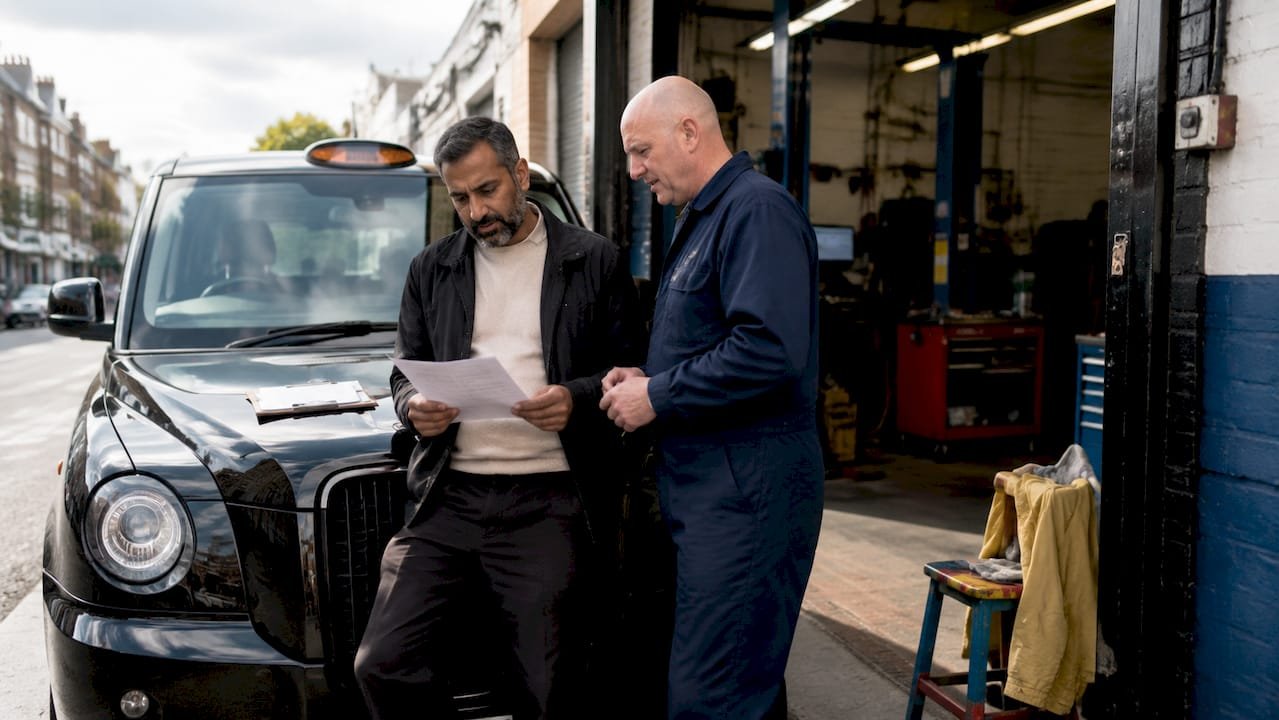
The MOT requirement for a Private Hire Vehicle (PHV) licence in London is defined as a mandatory twice-yearly MOT test for all vehicles over 12 months old, with each certificate issued within 14 days before the TfL inspection date. If you are working towards your PCO licence application or renewing an existing one, understanding what is mot requirement pco is not optional. Getting this wrong delays your licence and stops you earning. This guide covers every rule, every timing detail, and every practical step you need to stay compliant with TfL’s PCO MOT guidelines in 2026.
What is the MOT requirement for a PCO licence?
The MOT requirement for a PCO licence is set by Transport for London (TfL) and is stricter than standard UK law. TfL mandates that all licensed PHVs over 12 months old must pass two MOT tests per year to maintain licensing compliance. That means one MOT every six months, not once a year.

Vehicles under 12 months old are exempt from the MOT requirement at the point of initial licensing, but they must still meet all other TfL vehicle standards. Once your vehicle crosses the 12-month mark, the twice-yearly rule applies without exception. Missing either test puts your licence at risk.
The term “PCO” stands for Public Carriage Office, which was the former name of the body that regulated private hire vehicles in London before TfL absorbed that function. The correct current term is TfL Private Hire Vehicle (PHV) licensing, though “PCO” remains widely used by drivers and the industry. Both terms refer to the same licensing regime.
How do TfL MOT rules differ from standard UK MOT rules?
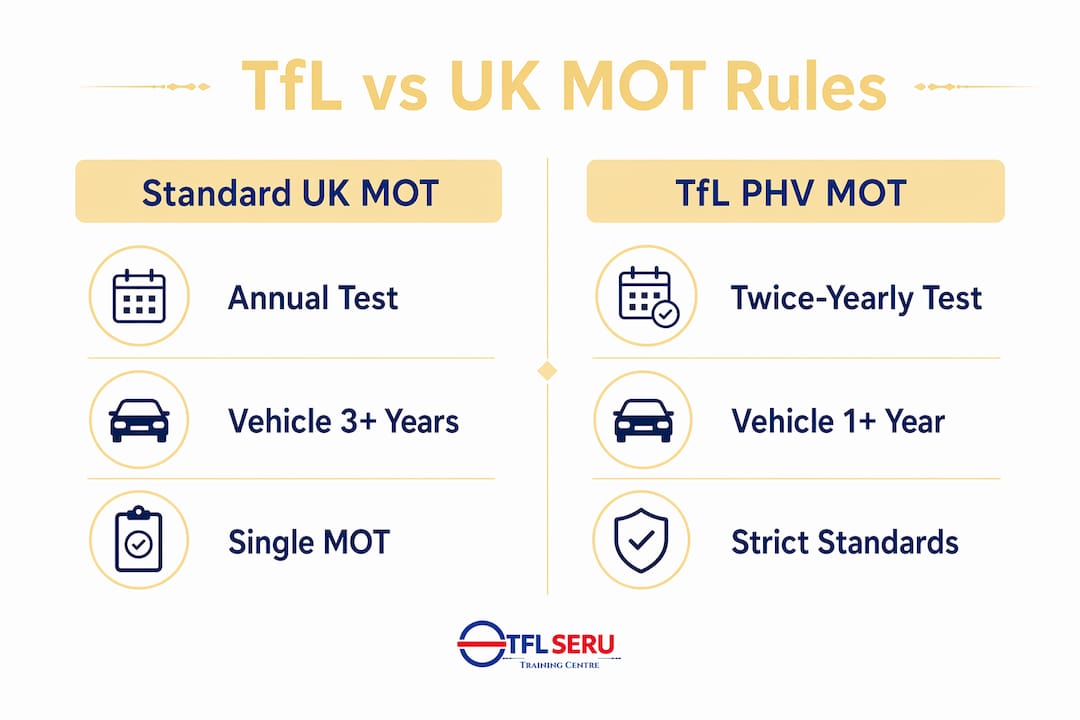
Standard UK law requires an annual MOT only for vehicles over three years old. TfL requires two MOTs per year after just 12 months, making the PHV regime significantly more demanding. This is not a minor difference. It doubles the testing frequency and brings the threshold forward by two years.
A common misconception among new drivers is that passing a standard annual MOT is sufficient for TfL licensing. It is not. TfL inspections include additional safety and environmental checks that go beyond the standard MOT scope entirely.
The table below shows the key differences clearly.
| Requirement | Standard UK MOT | TfL PHV MOT |
|---|---|---|
| Vehicle age threshold | 3 years old | 12 months old |
| Frequency | Once per year | Twice per year |
| Certificate validity window | No specific window | Within 14 days of TfL inspection |
| Additional TfL inspection | Not required | Required separately |
| Emissions compliance | Standard MOT check | ULEZ and zero-emission criteria apply |
The rationale behind the more frequent testing is straightforward. PHVs carry paying passengers and cover far higher annual mileage than private cars. A vehicle clocking 60,000 miles per year deteriorates faster than one doing 10,000. TfL’s twice-yearly MOT requirement reflects that reality and protects passenger safety.
When must your MOT certificate be issued?
Timing is the detail that catches most drivers out. The MOT certificate must be issued no more than 14 days before your TfL inspection appointment date. A certificate issued 15 days before the appointment is invalid for TfL purposes, even if it is technically still within its 12-month validity.
Here is what you need to know about timing and validity:
- Book your MOT first. Confirm the MOT date, then book your TfL inspection within the following 14 days.
- Do not book too far ahead. If you book your TfL appointment three weeks after your MOT, the certificate will be outside the 14-day window.
- Expired certificates cause rejection. An MOT certificate older than 14 days before the TfL inspection date will result in your vehicle being rejected, delaying licence approval and your ability to operate.
- Vehicles under 12 months are exempt. If your vehicle is less than 12 months old at the time of initial licensing, no MOT is required, though all other standards still apply.
- Plan around your inspection slot. TfL inspection appointments can be scarce. Once you have a slot, work backwards to schedule your MOT within the 14-day window.
The 14-day rule exists because TfL wants assurance that the vehicle’s condition at inspection closely matches its condition at MOT. A certificate from six weeks ago tells TfL very little about the vehicle today. Planning your MOT carefully is not bureaucratic box-ticking. It is the difference between a smooth licence renewal and a costly delay.
How to pass your PCO MOT: common failures and preparation tips
Failing an MOT is often the result of minor faults that routine checks would have caught. Common failure points include faulty light bulbs, tyre tread depth below the legal minimum of 1.6mm, and ineffective windscreen wipers. None of these require expensive repairs. All of them are avoidable.
Follow these steps to prepare your vehicle before the MOT:
- Check all lights. Walk around the vehicle and test every bulb, including brake lights, indicators, and reversing lights. Replace any that are out.
- Inspect tyre tread depth. Use a tread depth gauge. The legal minimum is 1.6mm, but TfL inspectors look for wear patterns too. Replace tyres that are uneven or close to the limit.
- Test your wipers and washers. Wipers that smear or fail to clear the screen are a common MOT failure. Top up washer fluid and replace worn blades.
- Check brake performance. Listen for grinding or pulling when you brake. Have a mechanic inspect pads and discs if you have any doubt.
- Verify emissions readiness. A cold engine produces higher emissions readings. Take the vehicle for a 15–20 minute drive before the MOT to bring the engine and exhaust to optimal temperature, reducing the risk of an emissions failure.
- Carry out a pre-MOT check 24–48 hours beforehand. A focused pre-MOT inspection covering bulbs, tyre pressure, and washer fluids significantly reduces the risk of failure on the day.
Pro Tip: Book your MOT at a garage that has experience with PCO vehicles. They understand TfL’s expectations and will flag issues that a standard MOT tester might overlook.
The financial consequences of failing an MOT are real. Platforms like Uber automatically check MOT status and suspend driver accounts when certificates expire. A failed or lapsed MOT does not just delay your licence. It stops your income immediately.
What other TfL vehicle standards apply beyond the MOT?
Passing the MOT is the starting point, not the finish line. TfL vehicle inspections are more rigorous than standard MOTs and include checks on bodywork condition, safety features, documentation, and environmental compliance. You need to meet all of these to receive or renew your PHV licence.
The table below outlines the key TfL vehicle requirements beyond the MOT.
| Requirement | Details |
|---|---|
| Valid MOT certificate | Issued within 14 days of TfL inspection |
| Hire and reward insurance | Must be in force and presented at inspection |
| Vehicle logbook (V5C) | Required to confirm registered keeper details |
| ULEZ compliance | Vehicle must meet Ultra Low Emission Zone standards |
| Bodywork condition | No significant damage, dents, or corrosion |
| Safety features | Partition screens and other features checked where applicable |
| Vehicle age limit | TfL sets maximum age limits for PHVs |
| Zero-emission criteria | Increasingly enforced as part of TfL’s clean air targets |
The ULEZ requirement deserves particular attention. TfL’s PCO approved vehicles list reflects the shift towards cleaner vehicles, and non-compliant vehicles face both ULEZ charges and potential licence refusal. If your vehicle does not meet the emissions standard, no amount of MOT preparation will resolve that issue.
Hire and reward insurance is a separate product from standard motor insurance. Standard comprehensive cover does not cover you for carrying paying passengers. TfL inspectors will check this document at the inspection, and operating without it is both a licensing offence and a criminal matter.
Understanding the full scope of TfL’s requirements means you arrive at your inspection prepared, not surprised. The TfL application process covers each of these requirements in sequence, so working through it methodically is the most reliable approach.
Key takeaways
TfL requires all PHVs over 12 months old to pass two MOT tests per year, with each certificate valid only within 14 days of the TfL inspection date, making timing and proactive maintenance the two most critical factors for compliance.
| Point | Details |
|---|---|
| Twice-yearly MOT required | TfL mandates two MOTs per year for PHVs over 12 months old, not the standard annual test. |
| 14-day certificate window | Your MOT must be issued within 14 days before your TfL inspection or it will be rejected. |
| Under 12 months exempt | Vehicles less than 12 months old are exempt from MOT but must meet all other TfL standards. |
| Pre-MOT preparation matters | Checking lights, tyres, wipers, and emissions 24–48 hours before the test reduces failure risk. |
| MOT is not the only check | TfL also inspects bodywork, insurance, ULEZ compliance, and safety features at the vehicle inspection. |
Why MOT compliance is the foundation of your PCO career
I have worked with hundreds of drivers preparing for TfL licensing, and the pattern is consistent. The drivers who treat the MOT as a genuine safety commitment, rather than a regulatory hurdle, are the ones who rarely face delays or unexpected failures. The drivers who leave it to the last minute are the ones who call in a panic because their certificate is 16 days old and their TfL appointment is tomorrow.
The twice-yearly MOT schedule is actually a useful discipline. It forces you to look at your vehicle closely every six months. Brakes that are wearing, tyres that are getting low, a bulb that has just gone. These are things you might not notice on a daily basis but that a structured check will catch. Catching them before the MOT costs far less than failing the test, rebooking, and delaying your licence.
The income risk is the part that does not get enough attention. A lapsed MOT certificate does not just create a paperwork problem. It can suspend your account on the platforms you depend on, with no warning and no grace period. Treating your MOT renewal dates with the same seriousness as your licence renewal dates is the single most protective habit you can build as a PCO driver.
— East
Start your PCO licensing journey with Eltconline
Meeting TfL’s MOT requirements is one part of a broader licensing process that includes the TfL Topographical Assessment, a test that many candidates find genuinely challenging. At Eltconline, based in Forest Gate, London E7, we specialise in preparing drivers for every stage of that process. You only get two attempts at the TfL Topographical Assessment before your entire application resets, which makes structured preparation non-negotiable. Our TfL topographical mock tests replicate the real exam conditions so you walk in confident, not guessing. If you are ready to start your private hire career on solid ground, Eltconline is the place to begin.
FAQ
How many mots does a PCO vehicle need per year?
TfL requires two MOT tests per year for all PHVs over 12 months old. This is double the standard UK requirement of one annual MOT for vehicles over three years old.
How recent does an MOT certificate need to be for TfL inspection?
The MOT certificate must be issued no more than 14 days before your TfL inspection appointment. A certificate older than 14 days will be rejected, and your inspection will not proceed.
Are new vehicles exempt from the PCO MOT requirement?
Yes. Vehicles less than 12 months old are exempt from the MOT requirement at the point of initial PHV licensing. All other TfL vehicle standards still apply to those vehicles.
What happens if my MOT expires while i am working as a PCO driver?
An expired MOT certificate puts your PHV licence at risk and can result in your account being suspended on platforms such as Uber, stopping your income immediately until a valid certificate is obtained.
Is passing the MOT enough to satisfy TfL vehicle requirements?
No. TfL conducts its own vehicle inspection that goes beyond the standard MOT, covering bodywork condition, hire and reward insurance, ULEZ compliance, and additional safety features. Both the MOT and the TfL inspection must be passed.
Recommended
- PCO approved vehicles list London: 2026 guide
- London PCO Licence Application
- Applying for a PCO Licence
- PCO Licence London- Apply for private hire driver licence | ELTC
