

The topographical pass mark is defined as a minimum score of 60 out of 100 marks on the TfL Topographical Assessment, the mandatory test every private hire vehicle (PHV) driver must pass before obtaining a licence to operate in London. This threshold, formally set by Transport for London (TfL), confirms that a candidate holds sufficient geographic knowledge and map-reading ability to navigate the capital without relying on GPS or digital aids. Understanding this pass mark is not just useful background knowledge. It is the single most important number in your entire licensing journey, and knowing exactly what it means shapes how you prepare, practise, and perform on test day.
What is topographical pass mark and why does 60% matter?
The 60% minimum pass mark means you must correctly answer enough questions to accumulate at least 60 marks from a total of 100. That sounds straightforward, but the practical implications go much further than the number itself.
Scoring exactly 60% leaves almost no room for error. A single moment of panic, a misread map symbol, or a poorly managed time block can push you below the threshold. That is why experienced trainers consistently advise candidates to aim for 80% or higher during practice sessions. Targeting 80% in preparation means that even under real test pressure, you are likely to land comfortably above 60%.

The stakes are also unusually high compared to most licensing exams. Candidates are permitted only two attempts at the TfL Topographical Assessment. Failing both means restarting the entire TfL application process, including resubmitting forms and paying fees again. That two-attempt limit makes treating the 60% pass mark as a bare minimum a genuinely risky strategy.
Key consequences of the 60% threshold at a glance:
- Scoring below 60% on any individual section counts as a fail, even if your overall total is higher
- A second failure triggers a full application restart, costing both time and money
- Passing at exactly 60% offers no buffer if TfL adjusts marking criteria between sittings
- Candidates who aim well above the minimum report significantly lower test-day anxiety
Pro Tip: Set your personal practice target at 80%, not 60%. If you consistently hit 80% on mock tests, a slightly below-par performance on the day will still keep you safely above the pass mark.
How is the topographical test structured and graded?
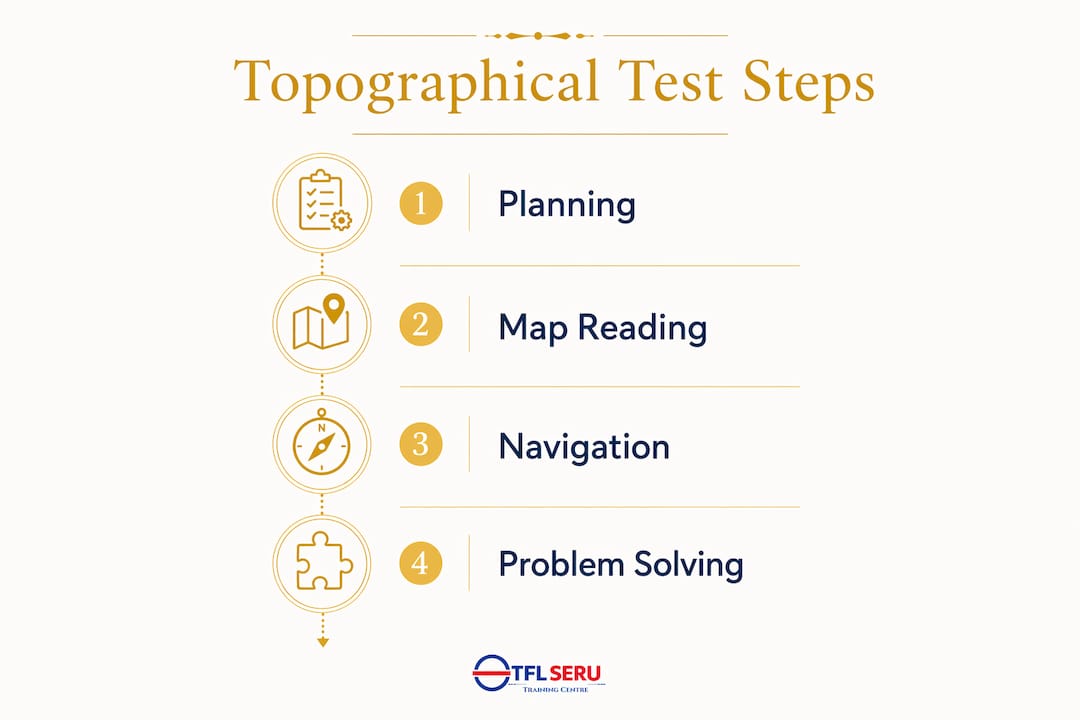
The test lasts approximately 60 minutes and is divided into four sections, each covering a distinct area of geographic and navigational knowledge. Every section carries its own marks, and you must achieve at least 60% in each section individually, not just across the paper as a whole. This is a detail many candidates overlook until it is too late.
Here is how the four sections break down:
| Section | Content focus | Approximate marks |
|---|---|---|
| Route planning | Plotting efficient routes across London using A-Z maps | 40 |
| Sign recognition | Identifying road signs, markings, and traffic signals | 20 |
| Map interpretation | Reading grid references, symbols, and map features | 25 |
| General knowledge | London landmarks, boroughs, and key locations | 15 |
Route planning carries the heaviest weighting. Route planning questions require strong geographic skills and accurate map reading, making them the section where most marks are won or lost. A candidate who masters route planning has a significant structural advantage over one who focuses only on sign recognition.
One critical rule works in your favour: there is no negative marking. A wrong answer costs you nothing beyond the mark you did not earn. This means leaving any question blank is a strategic mistake. An educated guess always gives you a chance of gaining a mark; a blank answer guarantees zero.
Pro Tip: Work through the route planning section first. It carries the most marks and rewards careful thinking. Leave sign recognition and general knowledge questions for the final minutes, using any remaining time to make educated guesses on anything you are unsure about.
Common challenges in meeting the topographical pass mark
Most candidates fail due to poor time management and anxiety rather than a genuine lack of knowledge. That finding is worth sitting with. It means the majority of people who do not reach 60% actually know enough to pass. They simply cannot access that knowledge efficiently under timed conditions.
Understanding the most common failure points helps you avoid them deliberately:
- Time overrun on route planning: Spending too long on a single complex route leaves insufficient time for other sections. Set a personal time limit per question during practice.
- Blank answers: Leaving questions unanswered is the most avoidable error. With no penalty for wrong answers, every blank is a wasted opportunity.
- Unfamiliarity with map symbols: Candidates who have not studied Ordnance Survey and A-Z symbols consistently lose marks on the map interpretation section.
- Test anxiety: Nerves cause candidates to second-guess correct answers. Familiarity with the test format, built through repeated mock tests, is the most reliable antidote.
- Ignoring section-level pass requirements: Focusing all revision on one section while neglecting others creates a structural weakness that can cause a fail even with a strong overall score.
The solution to most of these challenges is deliberate, timed practice rather than passive reading. Sitting with a map of London and tracing routes from Stratford to Westminster, or from Canary Wharf to Heathrow, builds the spatial memory that the test rewards. Reviewing the consequences of failing twice is also a useful motivator for taking preparation seriously from the start.
Pro Tip: Simulate real test conditions at least five times before your actual sitting. Use a timer, work in silence, and mark your own paper honestly. Familiarity with the pressure of the clock is a skill you can only build through repetition.
How to prepare effectively to surpass the topographical pass mark
Passing at 60% is the requirement. Passing confidently at 75% or above is the goal. The difference between those two outcomes comes down to the quality and consistency of your preparation in the weeks before the test.
Here is a structured preparation approach that works:
-
Start with the A-Z London map. Spend at least 30 minutes daily tracing routes between major landmarks, hospitals, railway stations, and borough boundaries. The test draws heavily from central and inner London geography, so prioritise zones 1 through 4.
-
Learn all standard road signs and markings. The Highway Code covers the full set. Focus on signs that appear at junctions, on motorways, and in pedestrian zones, as these appear most frequently in the sign recognition section.
-
Practise grid reference reading. Map interpretation questions often ask you to identify a location using a six-figure grid reference. This is a learnable skill that improves quickly with targeted practice.
-
Take timed mock tests regularly. Mock tests replicate the pressure of the real sitting. They reveal which sections drain your time and which question types you consistently get wrong. Use study techniques designed for the TfL test to structure your revision efficiently.
-
Review every wrong answer. Do not simply note your score and move on. Understand why each incorrect answer was wrong. This targeted review builds the specific knowledge gaps that mock tests expose.
-
Enrol in specialist training. Self-study works for some candidates, but structured topographical training with experienced tutors accelerates progress significantly. Tutors who know the TfL assessment format can identify your weak areas and correct them before test day.
Mastery, not minimum competence, is the preparation standard worth holding yourself to. Candidates who focus on mastery of London’s geography beyond the pass level consistently report greater confidence and better results on the day.
Key takeaways
The topographical pass mark is 60 out of 100, but candidates who prepare to score 80% or above are the ones who pass with confidence and avoid the costly consequences of a second failure.
| Point | Details |
|---|---|
| Pass mark definition | The minimum score is 60 out of 100 marks across all four test sections. |
| Section-level requirement | Each individual section requires at least 60%, not just the overall total. |
| Two-attempt limit | Failing both attempts forces a full TfL application restart, including fees. |
| No negative marking | Every question should be answered; blank answers guarantee zero marks. |
| Preparation target | Aim for 80% in practice to build a safe buffer above the 60% threshold. |
Why aiming at the minimum is the riskiest strategy
I have worked with hundreds of candidates preparing for the TfL Topographical Assessment, and the pattern I see most often is this: the candidates who aim for exactly 60% are the ones who call us after their second failed attempt. The candidates who set their sights on 80% are the ones who pass first time and move on to building their PHV career.
The test is not designed to be failed by people who know London. It is designed to filter out people who have not prepared seriously. That distinction matters. If you have put in the hours with your A-Z map, practised route planning from Bethnal Green to Brentford, and sat enough mock tests to feel comfortable with the clock, 60% is not a challenge. It becomes a floor, not a ceiling.
What I tell every candidate is this: the geography of London is learnable. The grid references, the one-way systems, the central reservation rules, the borough boundaries. All of it responds to consistent, focused study. The candidates who struggle are almost always the ones who underestimated the test or over-relied on their existing sense of direction. A good sense of direction is useful. Systematic map knowledge is what the test actually measures.
Approach the TfL Topographical Assessment as a professional qualification, not a formality. Prepare accordingly, and the 60% pass mark will take care of itself.
— East
Prepare with Eltconline and pass with confidence
Eltconline is a TfL-approved topographical assessment training centre based in Forest Gate, London E7, and we have helped thousands of candidates pass their test confidently on the first attempt. Our tutors understand exactly how the topographical grading criteria work and where candidates typically lose marks. We offer structured TfL topographical training programmes designed to take you from basic map familiarity to test-ready confidence. We also offer TfL topographical mock tests that replicate real test conditions, so you know exactly what to expect before you sit the actual assessment. Do not leave your two attempts to chance. Book your training or mock test with Eltconline today.
FAQ
What is the topographical pass mark for the TfL test?
The topographical pass mark is 60 out of 100 marks. Candidates must reach this threshold in each individual section of the test, not just as an overall total.
How many attempts do I get at the TfL Topographical Assessment?
You are permitted two attempts only. Failing both requires you to restart the entire TfL private hire driver application, including resubmitting paperwork and paying fees again.
Is there negative marking on the topographical test?
No. There is no negative marking, so you should answer every question, including ones you are unsure about. A guess carries a chance of earning a mark; a blank answer earns nothing.
What score should I aim for in practice?
Experts recommend targeting 80% or above during practice sessions. This buffer means that even if test pressure affects your performance slightly, you will still comfortably exceed the 60% pass mark.
Which section of the test carries the most marks?
Route planning carries the highest mark weighting and requires strong geographic skills and accurate map reading. Prioritising this section in your preparation has the greatest impact on your overall score.
Recommended
- Topographical test study techniques: 2026 guide
- Failed topographical test twice: what happens next
- What is topographical knowledge assessment for TfL drivers
