

The TfL Topographical Test is a mandatory assessment that measures your ability to read maps, plan routes, and demonstrate geographical knowledge of London without digital aids. Transport for London (TfL) requires every prospective private hire vehicle (PHV) driver to pass this test before obtaining a licence. The assessment proves you can navigate London’s streets professionally, even when GPS fails or signal drops. Understanding exactly what the test involves, what it covers, and how to prepare gives you the clearest path to passing on your first attempt.
What is the TfL Topographical Test and what does it assess?

The TfL Topographical Test, formally known as the TfL Topographical Assessment, is a compulsory navigation exam for all London private hire driver licence applicants. It tests whether you can operate as a professional driver without relying on GPS or digital navigation apps. TfL designed the test to confirm that drivers hold genuine geographical competency, not just the ability to follow a phone screen.
The test covers four main sections, each targeting a distinct navigation skill:
- Map reading: Using a physical London A-Z map, identifying locations via grid references, and interpreting map symbols correctly.
- Route planning: Plotting the shortest or most efficient route between two points across London’s road network.
- Geographical knowledge: Identifying London boroughs, zones, major airports such as Heathrow and Gatwick, hospitals, and key landmarks.
- Compass directions: Answering basic directional questions using north, south, east, and west orientation.
The pass mark sits at around 60%, and the test is timed. You sit the assessment on paper or a tablet at a TfL-approved centre. Knowing the format before you walk in removes a significant layer of anxiety on test day.
Common challenges candidates face in the TfL Topographical Assessment
More than 30% of candidates do not pass on their first attempt. That figure reflects one consistent problem: candidates prepare for a digital world but sit a physical test. The most frequent difficulties include:
- GPS dependency: Years of using Google Maps or Waze means many candidates have never practised reading a printed A-Z map under pressure. The physical format feels unfamiliar and slow.
- Poor time management: Slow map flipping wastes valuable minutes and risks leaving questions unanswered. Every second spent fumbling with pages is a second lost.
- Grid reference confusion: Many candidates misread or misapply grid references, leading to wrong location identification even when they know the area.
- Leaving questions blank: There is no negative marking in the TfL Topographical Test. A blank answer counts as incorrect. Guessing always gives you a better chance than leaving a question empty.
- Underestimating geographical breadth: Candidates often focus on central London and neglect outer boroughs, major arterial roads like the M25 and A40, and locations such as hospitals and train termini.
Pro Tip: Time yourself during every practice session from day one. Timed pressure is the single biggest shock on test day, and the only way to neutralise it is to replicate it in training.
How to prepare effectively and pass the TfL Topographical Test first time
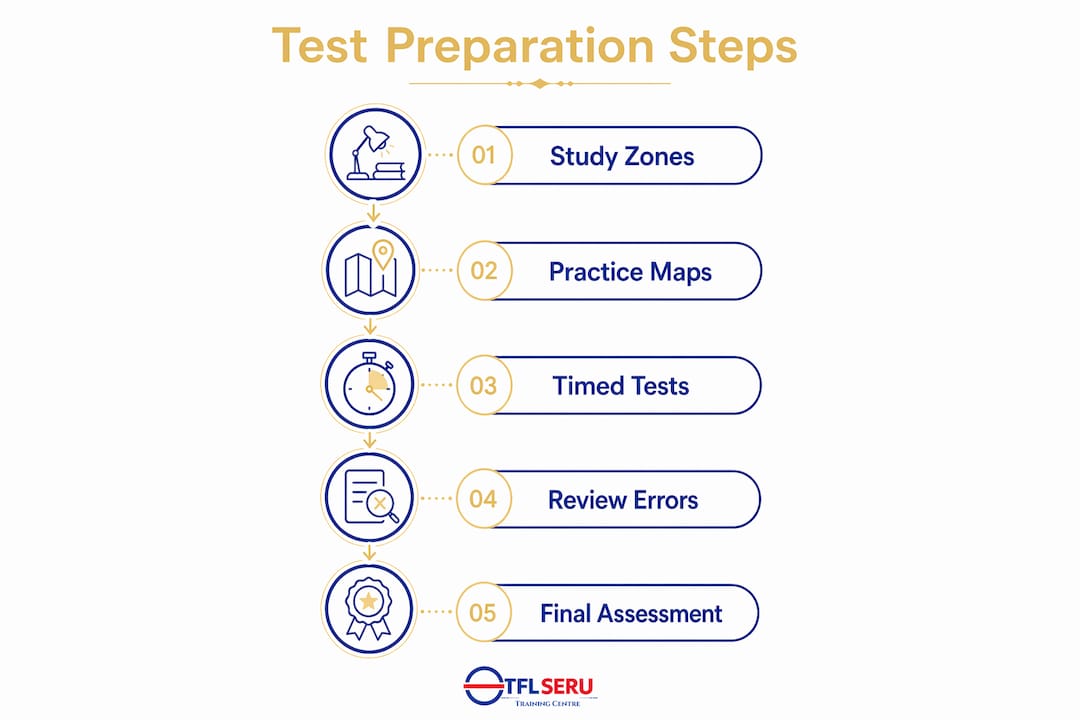
Passing the TfL Topographical Test on your first attempt is achievable with a structured preparation plan. The candidates who succeed treat this like a professional qualification, not a quick revision exercise. Follow these steps to build genuine competency:
-
Buy and use a physical London A-Z map. Digital apps will not prepare you for the test format. Practising with physical maps and drilling page-flipping speed builds the muscle memory you need under exam conditions.
-
Learn grid references thoroughly. Understanding grid references and map symbols allows you to navigate the physical test materials quickly. Practise locating addresses by grid reference daily until it becomes automatic.
-
Memorise key London geography. Study all 32 London boroughs, the six main airports, major hospitals, rail termini, and major roads including the M25 and A40. Route planning questions draw directly from this knowledge.
-
Run timed mock tests regularly. Timed practice tests improve first-time pass rates significantly. Set a timer and complete full mock papers under exam conditions at least three times per week.
-
Answer every single question. With no negative marking, leaving any question blank is a guaranteed lost mark. Always attempt an answer, even when uncertain.
-
Book a structured training course. Approved training centres provide expert guidance, structured mock exams, and feedback that self-study alone cannot replicate. Professional instruction accelerates your readiness considerably.
Pro Tip: Map out a rigorous study plan covering one London zone per day. By the end of two weeks, you will have covered the full geographic spread of the test without cramming.
Where and how to take the TfL Topographical Test: process and logistics
The TfL Topographical Test takes place at TfL-approved assessment centres across London. You must book your place in advance through an approved centre. The test is not available on demand.
| Detail | Information |
|---|---|
| First attempt cost | £40 |
| Retake cost | £30 |
| Maximum attempts | 2 before restarting your TfL application |
| Test format | Paper or tablet at an approved centre |
| ID required | Valid photo ID and booking confirmation |
Booking and pricing details are set by TfL directly. The two-attempt limit is the most critical rule to understand. If you fail twice, you must restart your entire TfL private hire driver application. That means additional time, cost, and delay before you can work. Treating each attempt with full preparation is not optional. It is the only sensible approach.
On test day, arrive early with valid photo identification and your booking confirmation. You will not be permitted to bring your own maps or notes. The test centre provides all materials. Mobile phones must be switched off and stored away before the assessment begins.
How the TfL Topographical Test fits into your PHV licence application
The TfL Topographical Assessment is one of two key assessments within the TfL private hire driver licensing process. The second is the SERU (Safety, Equality and Regulatory Understanding) assessment. Both must be passed before TfL will issue a private hire driver licence.
The topographical test serves a specific professional purpose:
- It confirms you can navigate London independently, without technology, in any situation.
- It protects passengers by ensuring their driver holds genuine geographical knowledge.
- It meets TfL’s standard for professional competency across the entire licensed fleet.
- Failing the test delays your licence application and, after two failed attempts, forces a full restart.
- Passing on your first attempt keeps your application on track and reduces overall cost.
Viewing the test as a professional standard rather than an obstacle changes how you prepare. Drivers who approach it this way tend to study more thoroughly and perform better. The test exists because professional navigation competency genuinely matters on London’s roads.
Key takeaways
The TfL Topographical Assessment is a mandatory, physical map-reading exam that requires structured preparation, timed practice, and thorough geographical knowledge to pass within two attempts.
| Point | Details |
|---|---|
| Test format and pass mark | Four sections covering map reading, route planning, geography, and compass directions, with a pass mark of around 60%. |
| Two-attempt limit | Failing twice means restarting your full TfL application, making thorough preparation non-negotiable. |
| No negative marking | Always answer every question; blank answers count as incorrect and reduce your score unnecessarily. |
| Physical map practice | Drilling with a London A-Z under timed conditions is more effective preparation than any digital app. |
| Professional context | The test sits alongside the SERU assessment as a core requirement for a TfL private hire driver licence. |
Why I think most candidates underestimate this test
Most people I speak with assume the TfL Topographical Test is straightforward because they know London reasonably well. That assumption is the single biggest reason candidates fail. Knowing a city from the passenger seat, or from years of following a sat-nav, is entirely different from reading a grid reference on a physical A-Z map under timed exam conditions.
The candidates who pass first time share one habit: they practise manual mapping drills consistently, replicating the test environment rather than studying passively. They time themselves. They cover outer boroughs, not just Zone 1. They answer every question, even when unsure.
The two-attempt rule changes the stakes considerably. This is not an exam you can afford to treat casually and resit cheaply. A failed second attempt means restarting your entire application. The professional and financial cost of that outcome far outweighs the effort of thorough preparation upfront.
My honest advice: treat this test with the same seriousness as a professional qualification, because that is exactly what it is. The drivers who do that pass. The drivers who do not, often wish they had.
— East
Prepare with confidence using Eltconline’s training and mock tests
Eltconline is a TfL-approved Topographical Assessment training centre based in Forest Gate, London E7. The centre has helped thousands of candidates pass their topographical test with confidence, using structured courses built specifically around the official exam format.
Eltconline offers TfL topographical mock tests that closely replicate the real assessment, giving you genuine exam practice before the day itself. The centre also provides specialist topographical training with expert tutors who know exactly what TfL examiners look for. Whether you prefer classroom sessions or home practice options, Eltconline has a format to suit your schedule. Book your place and give yourself the best possible chance of passing first time.
FAQ
What is the TfL Topographical Test?
The TfL Topographical Test is a mandatory assessment for London private hire driver licence applicants. It tests map reading, route planning, geographical knowledge of London, and compass directions without the use of digital aids.
How many attempts do you get at the TfL Topographical Assessment?
You get two attempts at the TfL Topographical Assessment. Failing both means you must restart your entire TfL private hire driver application from the beginning.
What is the pass mark for the TfL Topographical Test?
The pass mark is approximately 60%. The test covers four sections, and you must reach that threshold across the full assessment to receive a pass result.
Is there negative marking in the TfL Topographical Test?
There is no negative marking. Leaving a question blank counts as an incorrect answer, so you should always attempt every question, even when you are not certain of the answer.
How much does the TfL Topographical Test cost?
The first attempt costs £40. A retake costs £30. Both must be booked at a TfL-approved assessment centre in advance.
Recommended
- Topographical test study techniques: 2026 guide
- What is topographical knowledge assessment for TfL drivers
- TfL application process explained: 2026 guide
- TfL topographical assessment attempts explained
