
Failing the TfL Topographical Test twice means your entire private hire vehicle (PHV) licence application is reset to zero. This is the single most important fact every aspiring London PCO driver must understand before sitting the topographical knowledge assessment. You do not simply book a third attempt. Instead, you restart the full application process, paying all fees again and waiting through the entire administrative queue. Knowing what happens if you fail the topographical test twice gives you the motivation to treat every attempt with the seriousness it deserves.
What happens if you fail the topographical test twice?
Failing twice forces candidates to restart the application from scratch, causing months of delays and significant extra costs. That is not a minor inconvenience. It means resubmitting your PCO licence application to Transport for London, paying the full application fee again, and waiting for a new test slot to become available. Candidates who have been through this describe it as one of the most demoralising setbacks in their path to becoming a licensed private hire driver.
The official term for this assessment is the TfL Topographical Skills Assessment, though it is widely known as the topographical test. TfL uses it to confirm that PHV drivers can read and interpret London maps, identify grid references, and navigate routes safely. The test has strict marking criteria and time limits. Without proper preparation, even experienced drivers with strong navigation skills can fall short of the required standard.

The consequences of failing the topographical test extend well beyond the test room. Your application timeline resets entirely, your investment in the process so far is lost, and your income as a licensed driver is delayed further. For many candidates, this represents a serious financial and professional setback.
Why do candidates fail the topographical test twice?
Understanding why repeated failure happens is the first step to preventing it. The reasons are consistent across candidates and almost always come down to preparation, not ability.
- Misunderstanding the test format. The TfL Topographical Skills Assessment is not a general geography quiz. It tests specific skills such as reading A to Z map pages, identifying grid references, locating landmarks, and understanding one-way systems and central reservations. Candidates who revise general London knowledge without practising the actual test format are underprepared.
- Underestimating time pressure. The assessment is timed, and many candidates run out of time on questions they actually know. Without practising under timed conditions, the clock becomes a major obstacle.
- Treating the first attempt too casually. Experts stress that the first attempt should be treated as a serious, final-standard effort, not a trial run. Candidates who sit the test underprepared often use the first failure as a learning experience, then find the second attempt equally difficult without structured intervention.
- Topographical anxiety. The pressure of only two allowed attempts can cause significant test anxiety, which negatively affects performance even among well-prepared candidates. Nerves cause candidates to second-guess correct answers or misread map details under pressure.
- No mock test experience. Candidates who have never sat a practice assessment under real exam conditions are far more likely to struggle with the format, pacing, and question style on the day.
Pro Tip: Do not wait until after your first failure to seek professional training. Book a structured course before your first attempt. You only have two chances, and the cost of reapplication far exceeds the cost of good preparation.
What is the retake policy after two failures?
The retake policy is straightforward but unforgiving. TfL does not offer a third attempt within the same application cycle. Reapplication after two failures involves restarting the entire private hire licence procedure, including all associated fees and waiting times.
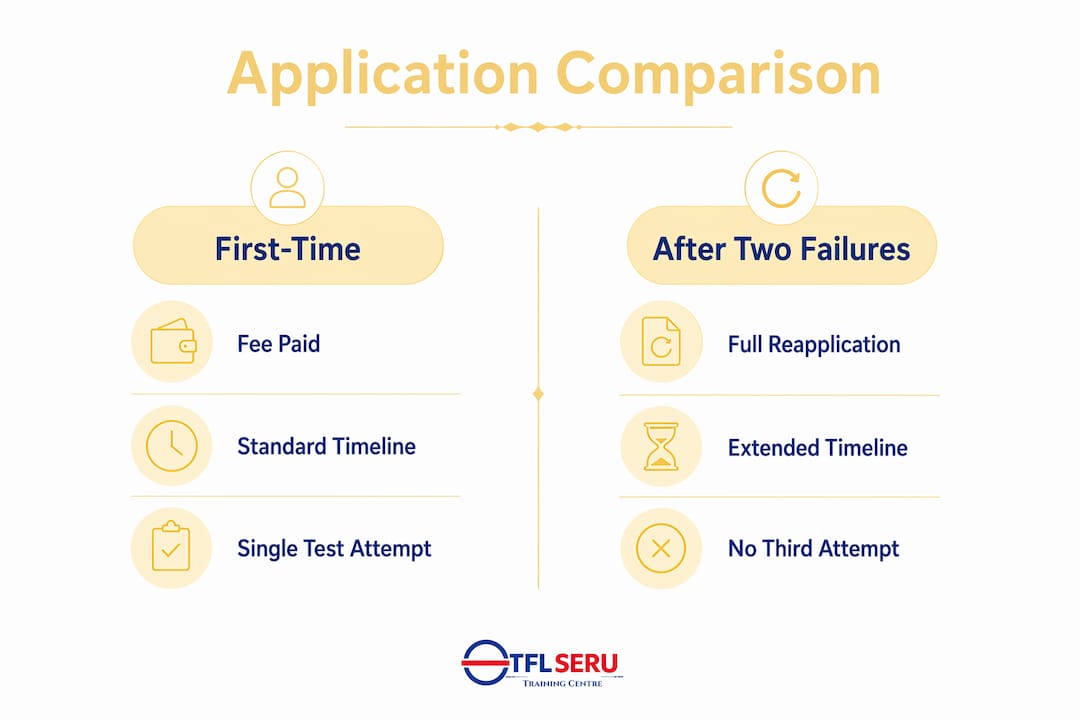
The table below compares the first-time application process with the reapplication process after two failed attempts.
| Stage | First-Time Application | Reapplication After Two Failures |
|---|---|---|
| Application fee | Paid once | Paid again in full |
| Documentation | Submitted once | Resubmitted from scratch |
| Test availability | Standard waiting time | Standard waiting time restarts |
| Training requirement | Recommended | Strongly advised before retaking |
| Career delay | Minimal if prepared | Months of additional delay |
| Financial impact | Standard costs | Doubled or more due to repeat fees |
The reapplication process typically adds several months to your timeline. During that period, you cannot legally operate as a PHV driver in London. For candidates who have already left previous employment or made financial commitments based on an expected start date, this delay creates real hardship. The failed topographical test implications are therefore both administrative and deeply personal.
How to prepare effectively for a retake
If you have failed once or are approaching your second attempt, the following steps give you the best chance of passing and avoiding a full reapplication.
- Enrol in a professional topographical training course. Structured professional training before a second attempt is strongly advised to close knowledge gaps rather than relying on repeated attempts. Eltconline’s TfL topographical training is designed specifically around the current TfL marking criteria, so you practise exactly what the assessors are looking for.
- Sit at least one full mock assessment. Mock tests aligned with TfL marking standards improve readiness, reduce anxiety, and enhance pass rates. A mock test reveals your weak areas before they cost you the real thing.
- Practise under timed conditions every session. Use a timer for every practice question. The test format and marking criteria differ from general knowledge, making timed practice vital. You need to build the habit of working quickly and accurately under pressure.
- Study the A to Z map systematically. Focus on grid references, major landmarks, one-way streets, and key routes across all London boroughs. Use the 2026 study techniques guide from Eltconline to structure your revision week by week.
- Manage test anxiety with preparation, not avoidance. Candidates experiencing topographical anxiety benefit markedly from mock assessments that simulate exam conditions. The more familiar the test environment feels, the less your nerves will interfere on the day.
- Practise from home between sessions. Eltconline’s home practice resources let you reinforce your learning between training sessions, which is particularly useful in the final two weeks before your test date.
Pro Tip: Map out a rigorous study plan covering at least four weeks before your retake. Divide London into zones and master one zone per week. This structured approach prevents the common mistake of trying to memorise everything at once.
How does failing twice affect your PCO licence and career?
The broader impact of two failed attempts goes well beyond the test itself. Failing twice significantly affects career trajectory due to the time lost restarting licensing and the financial costs of reapplication.
- Your licence application timeline resets completely. You cannot progress to the next stage of your PCO licence application until you pass the topographical assessment. A full restart means starting from the beginning of the queue.
- Lost earnings accumulate quickly. Every month you are not licensed is a month without PHV income. For candidates who have already invested in a vehicle, insurance, or other start-up costs, this delay is financially damaging.
- Additional fees add up. Reapplication means paying TfL’s application fee again, along with any training or test booking costs. The total additional outlay can be substantial.
- Motivational impact is real. Many candidates who fail twice report a significant drop in confidence. This is understandable, but it is also manageable. Targeted training with experienced instructors rebuilds both knowledge and confidence in a way that self-study alone rarely achieves.
- Early preparation is the most effective protection. Timely success reduces overall barriers to income and employment for London PCO drivers. Investing in proper training before your first attempt is always cheaper and faster than dealing with the consequences of two failures.
If you are currently in the reapplication process, consider reading about how to restart your driver training to understand the broader retraining mindset that helps candidates succeed on their next attempt.
Key takeaways
Failing the TfL Topographical Test twice triggers a full PCO licence reapplication, making professional training and mock assessments the most effective way to avoid this outcome.
| Point | Details |
|---|---|
| Two failures reset everything | You must reapply for the full PCO licence, paying all fees and waiting times again. |
| Preparation is the core issue | Most double failures stem from poor test-format preparation, not weak navigation ability. |
| Mock tests reduce risk | Sitting TfL-standard mock assessments before your attempt improves pass rates and reduces anxiety. |
| Career and financial costs are significant | Months of lost earnings and doubled fees make early preparation far cheaper than reapplication. |
| Professional training is the safest route | Structured courses aligned with TfL marking criteria give you the best chance on a retake. |
The uncomfortable truth about topographical test failures
I have worked with hundreds of candidates who came to us after failing once or twice, and the pattern is almost always the same. They knew London reasonably well. They had driven here for years. They assumed that familiarity with the city would carry them through the test. It does not.
The TfL Topographical Skills Assessment is not testing whether you know London. It is testing whether you can read a specific type of map, interpret grid references accurately, and do so quickly under timed conditions. Those are learnable skills, but they require deliberate practice. Candidates who treat the test as a formality and sit it without structured preparation are taking an unnecessary risk with their career.
What I find most frustrating is when candidates use their first failure as a learning experience without changing their preparation method. They revise a little harder, perhaps study a few more map pages, and sit the second attempt with the same fundamental gaps. The second failure then forces the full reapplication, which could have been avoided entirely with proper training before the first attempt.
If you are reading this after one failure, treat the second attempt as your final opportunity. Not because there is no path forward after two failures, but because the path is significantly longer and more expensive. Seek out professional topographical training before you rebook. Sit a full mock test. Understand exactly where your knowledge gaps are and address them systematically. That is the approach that works.
— East
How Eltconline can help you pass on your next attempt
If you have already failed once or are approaching your second attempt, Eltconline’s training programmes are built specifically for this situation.

Eltconline is a TfL-approved topographical training centre based in Forest Gate, London E7. Our TfL mock test sessions replicate the exact format, timing, and marking criteria of the official assessment, so you know precisely what to expect on the day. Our training packages are designed to close knowledge gaps efficiently, whether you are preparing for a first attempt or a retake after a previous failure. Thousands of candidates have passed their topographical test with our support. Book your place today and give yourself the best possible chance of passing first time.
FAQ
What happens if you fail the TfL topographical test twice?
Failing the TfL Topographical Test twice means you must restart your entire PCO licence application from scratch, including resubmitting documents and paying all fees again. This typically adds several months to your timeline before you can legally operate as a private hire driver in London.
Can you retake the topographical test a third time?
TfL does not permit a third attempt within the same application cycle. You must complete a full reapplication before you are eligible to sit the test again.
How long does reapplication take after two failed attempts?
The reapplication process follows the same timeline as a first-time application, which typically takes several months depending on TfL processing times and test slot availability.
What is the best way to prepare for a topographical test retake?
Enrolling in a professional training course and sitting at least one full mock assessment aligned with TfL marking standards is the most effective preparation method for a retake.
Does failing the topographical test affect your PCO licence application?
Yes. Failing twice resets your entire PCO licence application, delaying your ability to earn as a licensed PHV driver and increasing your overall costs through reapplication fees and lost income.
Recommended
- Topographical test study techniques: 2026 guide
- Tfl topographical test, practice from home |ELTC
- Topographical Test Training | Get quality training | ELTC
- Need topographical training | Topographical specialists

Pingback: What is topographical pass mark: your 2026 guide