

Accuracy in the TfL Topographical Test is the single most important skill that separates candidates who pass first time from those who face the costly process of restarting their entire PHV licence application. The test assesses your ability to read maps, identify grid references, interpret symbols, and plan routes across London’s complex road network, all within strict time limits. Getting these details right is not optional. Accuracy during preparation reduces time pressure stress, leading to increased speed and fewer mistakes under exam conditions. Understanding why accuracy matters in the topographical test gives you a clear foundation to build your preparation on.
Why accuracy matters in the TfL topographical test
Precision in map reading is the skill TfL examiners are directly testing when they assess your topographical knowledge. The exam requires you to locate streets, identify landmarks, read grid references, and trace routes, all without the assistance of GPS or digital navigation tools. A single misread symbol or incorrect grid reference can cost you the correct answer, and those errors accumulate quickly under timed conditions.
The topographical test significance goes beyond the exam room. Accuracy is not just about passing but also about professional competence once you are driving on London’s roads as a licensed private hire vehicle driver. Passengers rely on you to navigate efficiently, and the habits you build during preparation directly shape how you perform on the job.

The stakes are also unusually high compared to most licensing assessments. Candidates are allowed only 2 attempts to pass the TfL Topographical Test before restarting their entire PHV licence application. That means inaccuracy is not just a minor setback. It is a logistical and financial burden that can delay your career by months.
How does accuracy reduce stress during the test?
Stress in the exam room is almost always caused by uncertainty. When you are unsure whether you have read a grid reference correctly or identified the right landmark, your confidence drops and your pace slows. The reverse is equally true: candidates who have practised accurate map reading consistently find that the time pressure feels manageable rather than overwhelming.
Here is how accuracy directly improves your performance on the day:
- Faster decision-making. When you recognise map symbols and grid layouts immediately, you spend less time second-guessing and more time answering correctly.
- Reduced re-reading. Accurate candidates rarely need to re-examine a question. They read it once, locate the reference, and move forward.
- Calmer pacing. Knowing your map reading is reliable means you do not rush and introduce careless errors in the final minutes.
- Better route selection. Confident map interpretation allows you to identify the most direct route quickly, which is precisely what the test rewards.
- Lower anxiety overall. Preparation that focuses on precision builds genuine confidence, not just familiarity with the format.
Pro Tip: Practise answering questions against a stopwatch from the very beginning of your preparation. Timed practice with a stopwatch increases speed and accuracy, preparing you for real test conditions far more effectively than untimed revision.
What accuracy challenges do candidates commonly face?
Most candidates do not struggle with effort. They struggle with specific, identifiable gaps in their map reading skills. Recognising these challenges early gives you the opportunity to address them before they cost you marks.
- Overreliance on GPS. Many learners fail due to GPS reliance during preparation, which harms map reading skill development. If you have spent years navigating by phone, reading a printed A to Z map under time pressure will feel unfamiliar and slow.
- Difficulty with map indices and symbols. Understanding map indices and symbols accurately is crucial to interpret complex road networks under time constraints. Candidates who have not drilled these consistently often misidentify road types, one-way systems, or central reservations.
- Slow pace under timed conditions. Even candidates with solid map knowledge can underperform when the clock is running. Slow processing under pressure is a skill gap, not a knowledge gap, and it requires timed practice to fix.
- Incomplete landmark knowledge. London has hundreds of named locations, hospitals, stations, parks, and government buildings that appear regularly in test questions. Gaps in this knowledge force you to guess rather than recall.
- Inconsistent revision habits. Sporadic study sessions produce inconsistent results. Accuracy requires repetition, and repetition requires a structured schedule.
Pro Tip: Set aside GPS entirely during your study sessions. Manual map skills improve layout understanding and navigation in ways that digital tools simply cannot replicate. Use a printed London street atlas and practise locating addresses by grid reference alone.
Professional training vs self-study: which builds accuracy faster?
Both approaches can work, but they produce different outcomes at different speeds. The table below compares the two methods honestly so you can decide what suits your situation.
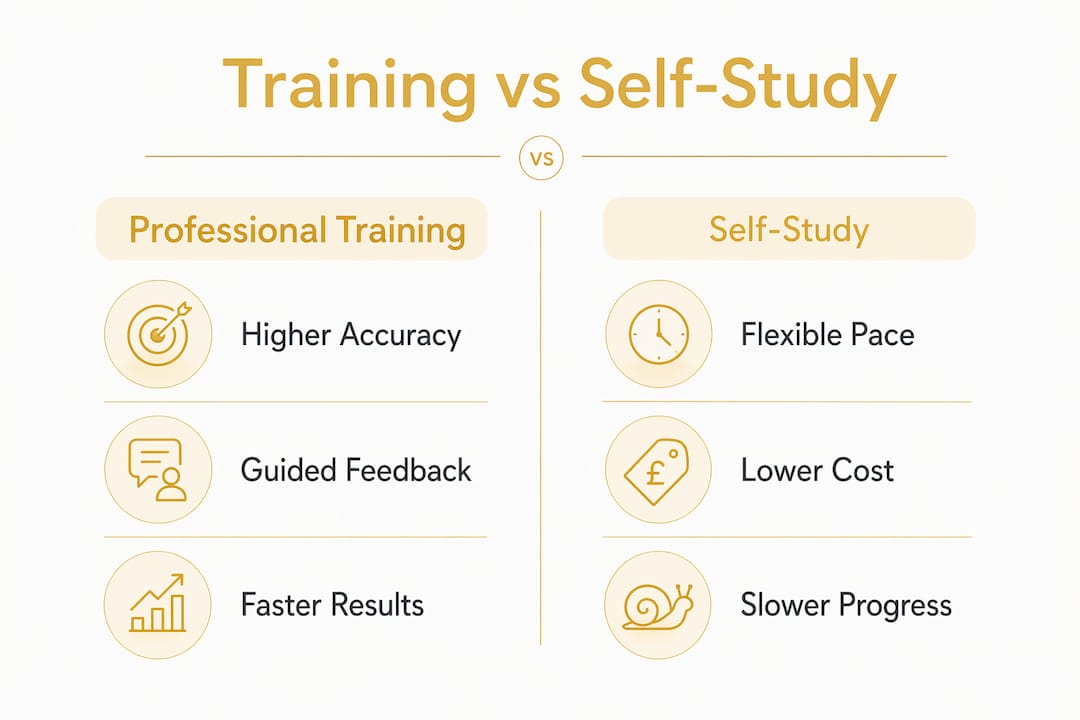
| Approach | Accuracy impact | Key advantage | Main limitation |
|---|---|---|---|
| Professional training | High. Trainers identify and correct specific accuracy errors quickly. | Personalised feedback reduces confusion and builds skills faster. | Requires time and financial commitment. |
| Self-study | Moderate. Progress depends on discipline and the quality of materials used. | Flexible schedule and lower upfront cost. | Risk of reinforcing bad habits without expert correction. |
| Blended approach | Highest. Combines structured guidance with independent practice. | Covers both knowledge gaps and exam technique. | Requires coordination between self-study and training sessions. |
Professional trainers identify accuracy as the strongest predictor of first-time test success. This is not a sales point. It reflects the reality that most candidates who fail do so because of specific, correctable accuracy errors that a trainer would have spotted and addressed during preparation. Self-study is valuable, but it works best when combined with at least some structured feedback from someone who knows the test format thoroughly.
Training also reduces re-application risks, which represent a significant logistical and financial burden to prospective PCO drivers. When you consider that failing twice means restarting the entire application process, the investment in professional support becomes straightforward to justify.
Techniques to improve your map reading accuracy
Building accuracy is a practical process. The following strategies are used by candidates who pass the TfL Topographical Test on their first attempt, and each one targets a specific aspect of precision.
- Practise without GPS. Spend at least 30 minutes per session working from a printed London street atlas. Locate addresses by grid reference, trace routes manually, and identify landmarks by their map symbols rather than their names.
- Run timed mock tests regularly. Simulate real exam conditions by setting a timer and working through practice questions without pausing. Review every incorrect answer immediately afterwards to identify the pattern behind the error.
- Build a landmark revision list. Regular revision of key London landmarks helps candidates recall and navigate more quickly. Create a list of hospitals, railway termini, major parks, and government buildings, then test yourself on their locations weekly.
- Use annotated maps and flashcards. Write the names of key locations directly onto a blank map outline, then cover them and recall from memory. Flashcards work particularly well for map symbols and road classification codes.
- Review errors systematically. After each practice session, group your mistakes by type. If you consistently misread grid references, that is your priority. If you confuse one-way systems with dual carriageways, focus there. Targeted revision produces faster improvement than general review.
You can find a detailed breakdown of these methods in Eltconline’s topographical test study techniques guide, which covers each approach with worked examples.
Pro Tip: Do not wait until you feel “ready” to attempt mock tests. Start them in your first week of preparation. Early exposure to test conditions reveals accuracy gaps you would not discover through passive study alone.
Why I believe accuracy must come before speed
Working with TfL Topographical Test candidates over many years, I have seen the same pattern repeat itself more times than I can count. A candidate arrives confident, having spent weeks studying. They know London reasonably well. They can name the major stations and describe the rough layout of the boroughs. Then they sit a timed mock test and their accuracy falls apart.
The reason is almost always the same. They prioritised coverage over precision. They tried to learn everything broadly rather than mastering the core skills deeply. Map reading accuracy is not something you acquire by osmosis. It requires deliberate, focused practice where you hold yourself to a high standard on every single question.
The candidates who pass first time are not always the ones who know the most. They are the ones who make the fewest errors under pressure. That distinction matters enormously when you only have two attempts available to you. I have seen candidates with impressive general knowledge of London fail because they misread a grid reference or confused a symbol. I have also seen candidates with more modest knowledge pass comfortably because their accuracy was consistent and their confidence was grounded in genuine skill rather than vague familiarity.
My advice is to spend your first two weeks of preparation doing nothing but accuracy drills. Forget speed entirely. Get every grid reference right. Get every symbol right. Get every landmark location right. Speed will follow naturally once accuracy becomes automatic. The reverse, trying to build accuracy after you have already trained yourself to rush, is far harder.
— East
How Eltconline helps you build the accuracy you need
Eltconline is a TfL-approved topographical training centre based in Forest Gate, London E7, and has helped thousands of candidates pass their assessment with confidence.
Our TfL topographical training programme is built around the accuracy skills that examiners test directly, covering map reading, grid references, symbol interpretation, and route planning under timed conditions. Every session includes personalised feedback so you know exactly where your accuracy gaps are and how to close them. We also offer a dedicated topographical mock test service that replicates real exam conditions, giving you the confidence to perform accurately when it counts most. With only two attempts available, preparation with Eltconline is the clearest path to passing first time.
FAQ
What is the TfL Topographical Test?
The TfL Topographical Test is a mandatory assessment for anyone applying for a private hire vehicle licence in London. It tests your ability to read maps, identify landmarks, interpret symbols, and plan routes across the city without GPS assistance.
Why does accuracy matter more than speed in the topographical test?
Accuracy matters more than speed because errors directly cost you marks, and consistent accuracy under timed conditions naturally produces faster performance. Candidates who prioritise precision during preparation make fewer mistakes when the clock is running.
How many attempts do you get at the TfL Topographical Test?
Candidates are allowed only 2 attempts before they must restart their entire PHV licence application. This makes first-time accuracy the most important goal of your preparation.
Does professional training genuinely improve accuracy?
Yes. Professional training provides personalised feedback and reduces confusion compared to self-study, helping candidates identify and correct specific accuracy errors before the exam.
How can I practise map reading accuracy at home?
Use a printed London street atlas and locate addresses by grid reference without any digital assistance. Combine this with timed mock tests and a structured landmark revision list to build both precision and speed progressively.
Key takeaways
Accuracy in the TfL Topographical Test determines first-time pass rates, professional competence on London’s roads, and your ability to avoid the significant cost of restarting a PHV licence application.
| Point | Details |
|---|---|
| Two-attempt limit | You have only two chances to pass before restarting your PHV application, making accuracy non-negotiable. |
| Accuracy reduces stress | Precise map reading builds confidence and lowers time pressure anxiety during the exam. |
| GPS reliance is a risk | Overreliance on digital navigation during preparation weakens the manual map skills the test directly assesses. |
| Professional training accelerates progress | Personalised feedback from a trained instructor corrects accuracy errors faster than self-study alone. |
| Timed drills build real precision | Practising under exam conditions from the start of preparation produces the accuracy and speed needed on the day. |
Recommended
- Topographical test study techniques: 2026 guide
- tfl topographical training | East London Training Centre
- Tfl topographical mock test | Sit for a mock test with ELTC
