

An enhanced background check via the Disclosure and Barring Service (DBS) is the mandatory mechanism TfL uses to confirm a PCO licence applicant’s good character and eligibility to work as a private hire driver in London. Understanding why background check PCO licence requirements exist is not optional knowledge. It is the foundation of your entire application, and getting it wrong can cost you months of delays.
Why does a background check matter for a PCO licence?
The Enhanced DBS check is a gatekeeping mechanism that protects passengers by verifying a driver’s criminal history and overall character. Private hire drivers are often alone with passengers in enclosed vehicles, trusted with personal circumstances and vulnerable individuals. That context makes thorough vetting a genuine public safety requirement, not a bureaucratic formality.
Transport for London (TfL) holds the authority to grant or refuse a PCO licence, and the enhanced DBS check sits at the centre of that decision. TfL combines the DBS result with medical assessments, topographical knowledge tests, and English language evaluations before issuing any licence. No single check replaces the others, but the DBS check is the first filter every applicant must clear.

The importance of PCO licence checks extends beyond the initial application. TfL uses the DBS Update Service to run ongoing status checks throughout the life of your licence. That means your character is assessed continuously, not just on the day you apply.
What does an enhanced DBS check actually examine?
The enhanced DBS check is significantly more thorough than a standard or basic check. It covers a wider range of records and intelligence sources that most applicants do not anticipate.
The check examines:
- Spent and unspent convictions. Both types appear on an enhanced certificate, unlike a standard check that only reveals unspent convictions.
- Cautions, reprimands, and warnings. These are included even if they did not result in a court appearance.
- Police intelligence and local force records. Local police intelligence and other sensitive data beyond formal convictions can appear on the certificate. This is the element that surprises most applicants.
- Government barred lists. The check confirms whether you appear on lists that prohibit working with vulnerable groups.
TfL assesses criminal history in context. The nature, timing, and relevance of any conviction all factor into the decision. A single minor caution from many years ago does not automatically disqualify you. TfL licensing authorities consider overall suitability and risk to passengers, not merely the presence of an offence on your record.
Pro Tip: Apply for your enhanced DBS check early in the PCO licence application process. Processing times vary, and delays at this stage can push back every other part of your application.
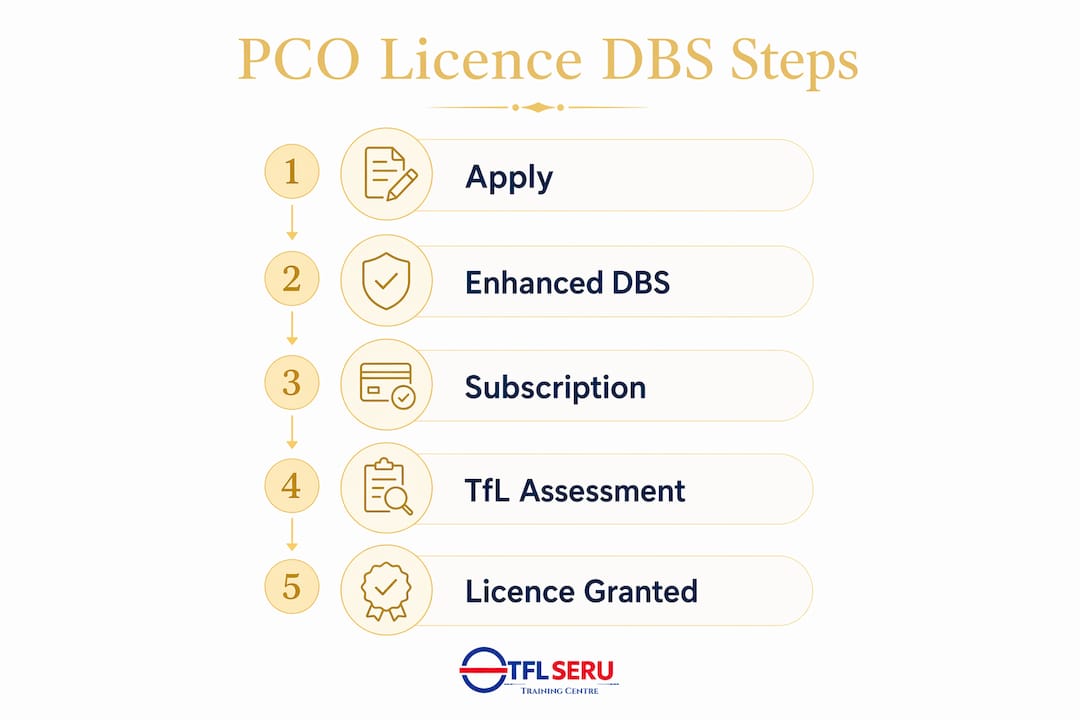
How does the background check fit into TfL’s full PCO licence requirements?
The DBS check is one part of a multi-stage assessment. TfL’s fit and proper person test draws on several distinct evaluations before a licence is granted. Understanding all of them helps you plan your application timeline realistically.
- Enhanced DBS check. Confirms your criminal history and character. You must register for the DBS Update Service at the same time to allow TfL’s ongoing checks.
- Medical examination. TfL requires drivers to meet DVLA Group 2 medical standards. These are the same standards applied to lorry and bus drivers, which are stricter than a standard driving licence medical.
- Topographical skills assessment. You must demonstrate knowledge of London’s geography, road network, and key landmarks. TfL administers this test directly, and you have only two attempts before your entire application resets.
- English language requirement. Applicants must pass a SERU (Safer Environment for Riders and Users) assessment that tests both English language ability and knowledge of passenger safety responsibilities.
- Right to work in the UK. TfL verifies your immigration status and legal right to work before issuing any licence.
Each stage must be passed before TfL will issue your PCO licence. The background check opens the door, but you must walk through every other stage too. Applicants who focus only on the DBS check and neglect topographical preparation often find themselves stalled at stage three.
Why does the DBS Update Service subscription matter so much?
Maintaining an active DBS Update Service subscription is one of the most overlooked requirements in the entire PCO licence process. Many applicants treat the initial DBS check as a one-time task. It is not.
TfL conducts six-monthly DBS status checks via the Update Service to monitor ongoing eligibility between licence renewals. This proactive approach means TfL can identify issues early rather than waiting for a renewal cycle. If your subscription lapses, TfL cannot run those checks, and your licence validity is put at risk.
The practical consequences of a lapsed subscription are significant:
- You must apply for a brand new enhanced DBS check from scratch, which takes time and money.
- Your licence renewal may be delayed or refused until the new certificate is processed.
- Any gap in your subscription history raises questions about compliance that TfL will need to resolve.
The annual subscription fee for the DBS Update Service is modest. Set a calendar reminder at least four weeks before your renewal date to avoid any lapse. Do not wait for a reminder from TfL, because one will not arrive.
Pro Tip: Register for the DBS Update Service within 19 days of your DBS certificate being issued. Miss that window and you will need to apply for an entirely new DBS check before you can subscribe.
What does the background check mean for your employment as a private hire driver?
Passing the background check and holding a valid PCO licence directly determines your ability to work as a private hire driver in London. Employers depend on valid DBS and TfL checks to confirm driver suitability before offering work. No licence means no work, regardless of your driving experience or local knowledge.
The table below shows how the background check outcome affects your employment prospects at different stages.
| Scenario | Employment impact |
|---|---|
| Clean DBS, licence granted | Full access to private hire work via operators such as Uber, Addison Lee, and local firms |
| Minor conviction, licence granted | Employment possible; some operators may apply additional screening |
| Conviction flagged, licence refused | No legal right to operate as a PHV driver in London |
| Lapsed Update Service subscription | Licence validity at risk; operator may suspend you pending resolution |
| Active subscription, clean status | Smooth licence renewal and uninterrupted employment |
The background check also builds trust with passengers. Riders using apps such as Uber or Bolt can see that their driver holds a valid TfL licence. That licence is only possible because the driver passed an enhanced DBS check. The check is therefore both a legal requirement and a commercial asset.
Past convictions do not automatically end your prospects. TfL’s contextual assessment means that older, minor offences may not prevent licensing. The key is transparency. Attempting to conceal a conviction is treated far more seriously than the conviction itself.
Key takeaways
The enhanced DBS check is the mandatory foundation of every PCO licence application, and maintaining an active DBS Update Service subscription is equally critical to keeping that licence valid.
| Point | Details |
|---|---|
| Enhanced DBS check is mandatory | TfL requires it to confirm good character before granting any PCO licence. |
| Check scope is broader than expected | Spent convictions, cautions, and local police intelligence all appear on the certificate. |
| Update Service subscription is ongoing | TfL runs six-monthly checks; a lapsed subscription risks your licence validity. |
| Convictions assessed in context | TfL considers the nature and timing of offences, not just their presence on your record. |
| Background check affects employment | Operators require a valid licence backed by DBS compliance before offering private hire work. |
Background checks are not red tape. They are the job.
I have spoken with many PCO licence applicants over the years who approach the enhanced DBS check as an obstacle to get past. That framing is understandable, but it is wrong. The check exists because private hire drivers occupy a position of genuine trust. You are alone with strangers, often late at night, in a vehicle they cannot easily leave. The public has a right to know that the person driving them has been properly vetted.
What concerns me more than the check itself is how often applicants mismanage the DBS Update Service. I have seen drivers lose their licence not because of anything on their record, but because they let their subscription lapse and did not realise the consequences until TfL contacted them. That is an entirely avoidable situation. The initial DBS check gets most of the attention, but the Update Service is where ongoing compliance lives.
The other misconception worth addressing is the idea that a past conviction automatically ends your chances. TfL does not operate a blanket ban. The licensing authority looks at what happened, when it happened, and whether it is relevant to the risk you pose as a driver. Applicants who are honest and can demonstrate rehabilitation often receive licences. Applicants who attempt to hide their history almost never do.
My advice is straightforward. Treat the background check as the professional standard it is. Manage your Update Service subscription like a direct debit. And if you have anything on your record, be upfront with TfL from the start.
— East
Prepare for every stage of your PCO licence with Eltconline
Eltconline is a TfL-approved topographical assessment training centre based in Forest Gate, London E7. The team has helped thousands of applicants pass the topographical test confidently, including those who were anxious about their limited attempts.

You only get two attempts at the TfL topographical assessment before your entire application resets. That makes preparation non-negotiable. Eltconline offers structured topographical training courses designed to build your London geography knowledge efficiently, alongside TfL topographical mock tests that replicate the real exam conditions. Whether you are at the start of your PCO licence application or preparing for a specific assessment, Eltconline has the training to support you at every step.
FAQ
What is an enhanced DBS check for a PCO licence?
An enhanced DBS check is a detailed criminal record check required by TfL for all PCO licence applicants. It covers spent and unspent convictions, cautions, and local police intelligence to assess whether an applicant is a fit and proper person to carry passengers.
Does a past conviction automatically disqualify a PCO licence application?
Not automatically. TfL assesses convictions in context, considering the nature, timing, and relevance of the offence. Minor or older convictions do not always prevent licensing, but attempting to conceal them will.
What happens if my DBS Update Service subscription lapses?
If your subscription lapses, TfL cannot run its six-monthly status checks and you will need to apply for a new enhanced DBS certificate from scratch, which can delay your licence renewal significantly.
How many assessments does TfL require for a PCO licence?
TfL requires an enhanced DBS check, a DVLA Group 2 medical examination, a topographical skills assessment, a SERU English language test, and proof of right to work in the UK. All must be passed before a licence is granted.
How does the background check affect my ability to find private hire work?
Operators require a valid PCO licence backed by a current DBS check before offering private hire work. Without a valid licence, you cannot legally operate as a PHV driver in London, regardless of driving experience.
Recommended
- Apply for PCO Licence
- PCO application timeline explained: 2026 guide
- PHV vs PCO licence: what’s the difference in 2026?
- London PCO Licence Application
