

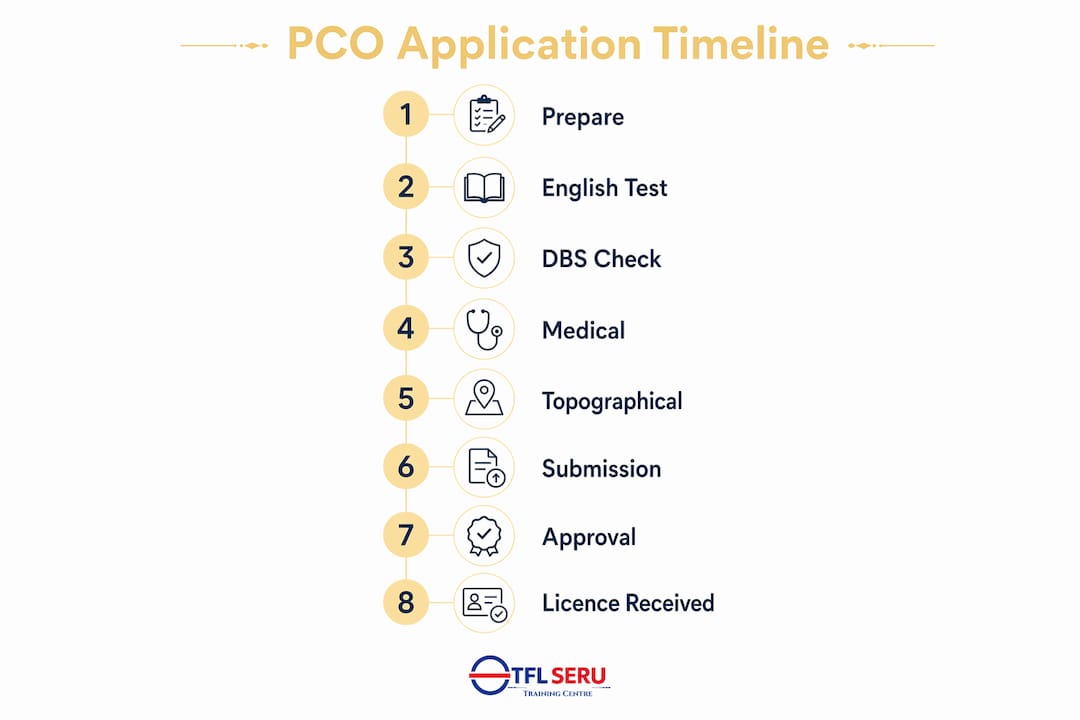
The PCO application timeline is the full sequence of stages a Private Hire Vehicle (PHV) driver must complete to receive a licence from Transport for London (TfL), from initial preparation through to final approval. The entire process takes 8–16 weeks, depending on how quickly you prepare and how busy TfL’s processing team is at the time. Understanding the pco application timeline explained in full means knowing exactly which stages to expect, what documents you need, and where delays most commonly occur. The key stages include safeguarding training, English language and topographical assessments, document submission via the TfL online portal, and the TfL review period before your licence is issued.
What are the main stages of the PCO application process?
The PCO application processing stages follow a fixed sequence. You cannot skip ahead or submit your online application before completing the required assessments. Here is how the process breaks down in order.
-
Safeguarding Awareness Training. TfL requires all new applicants to complete an approved safeguarding awareness course before applying. This typically takes one day and can be booked through TfL-approved providers. Allow one to two weeks to find an available slot and complete the course.
-
English Language Assessment. Since october 2021, TfL has required applicants to pass a separate English language assessment rather than relying solely on qualifications. Booking and sitting the test usually adds one to three weeks to your timeline. If you hold UK GCSEs at grade C or above, you may qualify for an exemption from testing, which saves both time and fees. Check your eligibility before booking.
-
Topographical Skills Assessment. This is the stage most applicants underestimate. The TfL Topographical Skills Assessment tests your knowledge of London streets, landmarks, and route planning. You only get two attempts before your entire TfL application resets. Allow two to four weeks for preparation and booking. Thorough preparation is not optional here.
-
Online Application Submission via TfL Portal. Once your assessments are complete, you submit your full application through the TfL online portal. Required documents include your DBS certificate, medical report, HMRC tax check code, driving licence, and proof of address. Missing even one document causes a processing delay.
-
TfL Review Period. After submission, TfL reviews your application. Review times vary based on application volumes but typically run several weeks. During peak periods, this stage can extend beyond the average estimate, so build buffer time into your plan.
Pro Tip: Book your English language and topographical assessments as early as possible. Test slots fill up quickly, and waiting for a date is one of the most common causes of a longer-than-expected timeline.
What causes delays in the PCO application timeline?
Most delays in the PCO application review duration are preventable. Understanding the causes puts you in control of your own schedule.
-
Incomplete documentation. Incomplete applications are the single biggest cause of processing backlogs. TfL will not progress your application if any required document is missing. A missing HMRC tax check code or an expired DBS certificate can add weeks to your wait.
-
Failing the Topographical Skills Assessment. Insufficient preparation is the most common reason applicants fail this test. Failing once means rebooking and waiting for another slot. Failing twice means restarting your entire TfL application, including fees and assessments.
-
Delays in DBS or medical checks. The Disclosure and Barring Service (DBS) check and your medical report both take time to arrange. A standard DBS check can take two to four weeks. If you wait until after submitting your application to arrange these, you will create an avoidable bottleneck.
-
TfL workload fluctuations. TfL’s processing times extend during high-volume periods. Applying during busy periods, such as after major regulatory changes, can add extra weeks to the review stage.
-
English language test delays. Applicants who are unaware of the 2021 update sometimes arrive underprepared or book the wrong test. This adds unnecessary time and cost to the process.
Pro Tip: Start your DBS check and arrange your medical appointment before you sit your assessments. Both processes run in parallel, so you can have them ready the moment your assessments are passed.
How should you time your PCO licence renewal?

The PCO licence is valid for three years. That sounds like a long time, but the renewal process requires the same level of planning as the original application. Getting the timing wrong can cost you your right to work.
TfL recommends starting renewal four months before your licence expires. This window gives you enough time to gather updated documents, book any required assessments, and allow for TfL’s review period without any gap in your work eligibility.
The critical rule to know: if your licence expires and you do not renew within three months of the expiry date, you lose renewal status entirely. That means a full restart, including retaking all assessments and paying all fees again. This is a costly mistake that is entirely avoidable with a simple calendar reminder.
The table below summarises the recommended renewal schedule.
| Stage | Recommended Timing |
|---|---|
| Set renewal reminder | 5 months before expiry |
| Begin gathering updated documents | 4 months before expiry |
| Book any required assessments | 3–4 months before expiry |
| Submit renewal application via TfL portal | 3 months before expiry |
| Allow for TfL review period | 6–8 weeks before expiry |
| Receive renewed licence | Before expiry date |
For a detailed walkthrough of the renewal process, the PCO licence renewal guide on Eltconline covers the updated requirements and document checklist for 2026.
What practical steps help you move through the process efficiently?
Understanding the pco application timeline overview is one thing. Moving through it efficiently is another. These steps will help you avoid the most common hold-ups.
-
Gather all documents before you start your online application. Your DBS certificate, medical report, HMRC tax check code, driving licence, and proof of address should all be in hand before you log into the TfL portal. Submitting an incomplete application pauses your progress immediately.
-
Check your English language test exemption status early. If you have UK GCSEs at grade C or above in English, you may not need to sit the assessment at all. Confirming this before booking saves you both time and money.
-
Prepare thoroughly for the Topographical Skills Assessment. This is not a test you can pass on general knowledge of London. You need to know grid references, one-way systems, central reservations, and key landmarks across the city. Early and comprehensive training substantially increases your chance of passing on the first attempt. Study techniques and mock tests are available through the topographical test study guide on Eltconline.
-
Monitor your application status on the TfL portal regularly. TfL may request additional documents or clarification during the review stage. Responding quickly to any such requests prevents unnecessary delays.
-
Set calendar reminders for every key date. Book your test slots, note your submission date, and mark your expected licence receipt date. If you are renewing, set your four-month reminder the day you receive your current licence.
-
Enrol with a specialist training centre early. The topographical assessment requires structured preparation. Eltconline, based in Forest Gate, London E7, is a TfL-approved training centre that has helped thousands of candidates pass their topographical test with confidence. Enrolling early means you complete your preparation in time to book your assessment without delay.
For a full breakdown of the TfL application process, including what to expect at each assessment stage, Eltconline’s 2026 guide covers everything in detail.
Key takeaways
The PCO application timeline takes 8–16 weeks from preparation to licence receipt, and the applicants who complete it fastest are those who prepare all documents and assessments in advance.
| Point | Details |
|---|---|
| Total timeline duration | The full process takes 8–16 weeks depending on preparation speed and TfL workload. |
| Two-attempt rule | You have only two attempts at the Topographical Skills Assessment before a full application restart. |
| Document readiness | Gather your DBS certificate, medical report, and tax check code before submitting your application. |
| Renewal timing | Begin renewal four months before expiry to avoid losing work eligibility. |
| Three-month expiry rule | Missing the three-month post-expiry window means restarting the entire application from scratch. |
What the PCO timeline taught me about preparation
Candidates consistently underestimate the Topographical Skills Assessment. They assume that driving in London for a few years gives them enough knowledge to pass. It does not. The test requires precise recall of grid references, specific road layouts, and named landmarks across the whole of Greater London. General familiarity with the city is not the same as tested knowledge.
What I have observed is that the applicants who complete the PCO process in the lower end of the 8–16 week range share one habit: they treat preparation as a project, not an afterthought. They book their DBS check and medical appointment before they even sit their assessments. They check their English language exemption status on day one. They enrol in structured topographical training rather than hoping self-study will be enough.
The three-month post-expiry rule is another area where experienced drivers make avoidable mistakes. After three years of holding a licence, it is easy to assume renewal is straightforward. Missing the window and having to restart from scratch is a genuinely disruptive outcome, both financially and professionally.
My honest advice: treat the four-month renewal window as a firm deadline, not a suggestion. And if you are a new applicant, do not attempt the Topographical Skills Assessment without structured preparation. The two-attempt limit makes underpreparation a serious risk.
— East
Start your PCO journey with expert training from Eltconline
Passing the Topographical Skills Assessment is the stage where most applicants lose time. Eltconline is a TfL-approved training centre in Forest Gate, London E7, with a proven record of helping candidates pass their topographical test on the first attempt.
Whether you are preparing for your first application or approaching renewal, Eltconline offers TfL topographical mock tests that replicate real exam conditions, as well as structured training packages designed to build your knowledge of London streets, grid references, and route planning efficiently. Enrolling early means your preparation aligns with your assessment booking, keeping your overall timeline on track. Visit Eltconline to find the right course for your stage in the PCO licence application process.
FAQ
How long does the PCO application process take?
The PCO application typically takes 8–16 weeks from initial preparation to receiving your licence. The exact duration depends on how quickly you complete assessments and how busy TfL’s review team is.
What documents do i need to apply for a PCO licence?
You need a DBS certificate, medical report, HMRC tax check code, driving licence, and proof of address. Submitting all documents together prevents processing delays.
How many attempts do i get at the topographical skills assessment?
You get two attempts at the TfL Topographical Skills Assessment. Failing both means restarting your entire TfL application, including all fees and assessments.
When should i start my PCO licence renewal?
Start the renewal process four months before your licence expires. If you miss renewing within three months of expiry, you must complete a full new application rather than a renewal.
Do i need to sit an english language test for my PCO application?
Most applicants must pass an English language assessment. However, if you hold a UK GCSE in English at grade C or above, you may qualify for an exemption, saving you time and the cost of the test.
Recommended
- Apply for PCO Licence
- Applying for a PCO Licence
- London PCO Licence Application
- PHV vs PCO licence: what’s the difference in 2026?

Pingback: Why background check PCO licence: your 2026 guide