
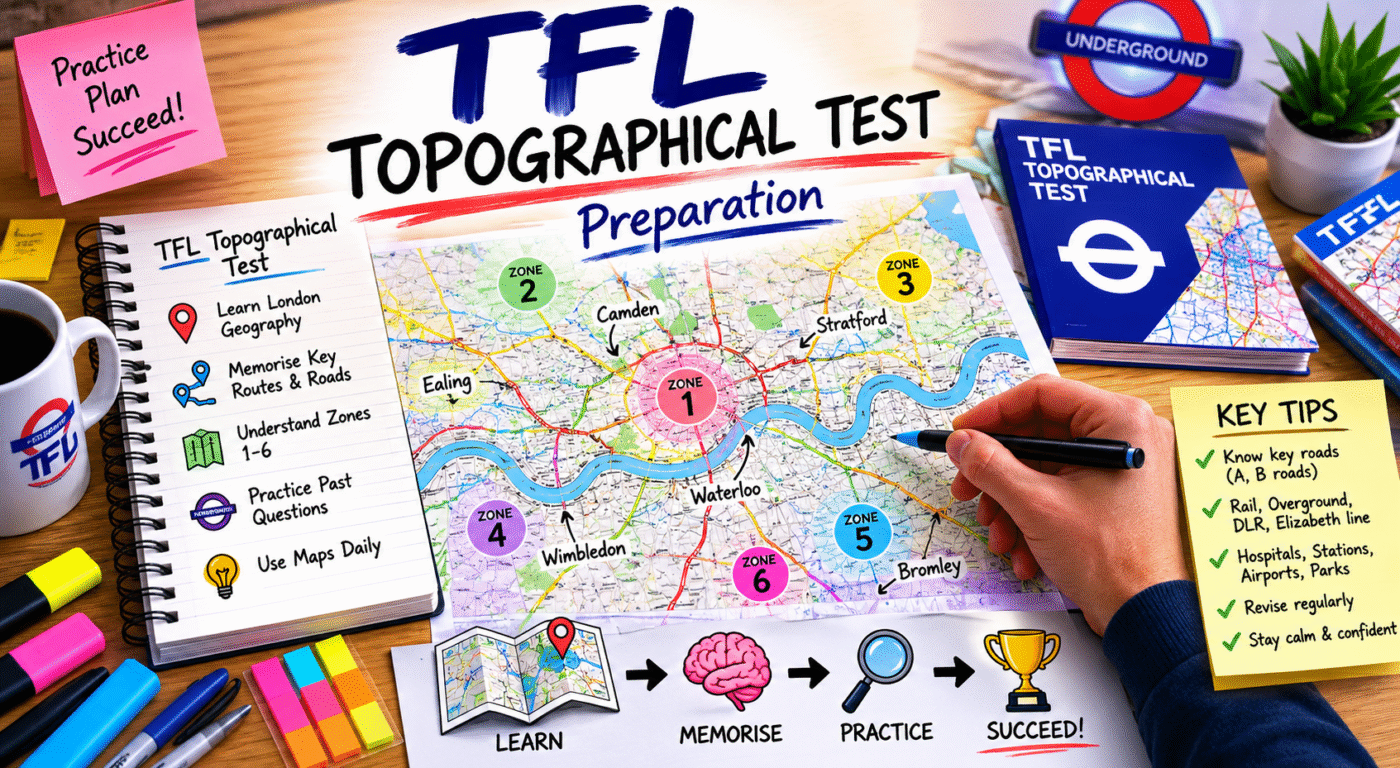
Becoming a licensed private hire driver in London is a rewarding career choice, offering flexibility and excellent earning potential. However, the path to getting your license requires passing several rigorous exams. As part of the updated PHV driver licensing requirements 2025, demonstrating an impeccable understanding of London’s intricate road network is absolutely non-negotiable. Whether you are just starting your application or gearing up for your test day, understanding the exact format of the exam is the key to your success. In this article, we will explore the essential TFL topographical test sample questions (2025-2026), break down the core modules, and provide actionable tips to help you pass on your first attempt.
What to Expect in the Topographical Exam
To pass the topographical exam, you need much more than just a basic sense of direction. The test measures your ability to navigate the capital safely, legally, and efficiently without solely relying on a sat-nav. For a complete overview of what the exam entails, consulting a comprehensive London PCO topographical assessment guide is highly recommended.
Many new candidates often ask about the differences between SERU and topographical exams. While the SERU (Safety, Equality and Regulatory Understanding) test focuses on passenger safety, driver behavior, and Transport for London regulations, the topographical assessment is purely about map-reading and route planning. Both are mandatory, but they require entirely different preparation and revision strategies.
Essential Map-Reading Skills
At the heart of the assessment is your ability to use physical and digital maps. The computer-based test interface replicates traditional map books, meaning that getting comfortable using Master Atlas of Greater London is crucial. Developing a personal London map reading skills guide will be your greatest asset during preparation.
You will be thoroughly tested on compass directions and grid references. This means you must know how to:
- Locate specific index pages quickly.
- Pin down alphanumeric grid squares (e.g., Grid K4).
- Figure out the most direct route between points using standard A to Z London Map navigation techniques.
- Determine the geographical relationship between two points (e.g., knowing if one borough is North-West or South-East of another).
TFL Topographical Test Sample Questions (2025-2026)
When hunting for study resources, many applicants look for a tfl topographical test questions pdf. While offline PDFs and printed worksheets are great for brushing up on fundamental theory, getting hands-on with the actual test format is better.
Here is a breakdown of the typical tfl topographical test questions you will face, divided into the main modules:
1. Map Index Questions
You will be asked to find the exact grid reference and page number for specific streets, stations, or points of interest.
- Sample Question: “Using the master index, find the page number and grid reference for Baker Street Station.”
- Tip: Always check the spelling carefully. London has many streets with identical or similar names (e.g., Church Road vs. Church Street).
2. Compass and Directional Questions
These questions test your general spatial awareness of the Greater London area.
- Sample Question: “What direction would you be travelling if you drove from Heathrow Airport directly to Canary Wharf?”
- Sample Question: “Which of the following towns is located South-West of Croydon?”
3. Route Planning (Short, Medium, and Long)
This is the most heavily weighted section of the test. You will be required to draw a line representing the most direct and legal route between a starting green marker and a finishing red marker.
- Sample Question: “Draw the most direct route from Victoria Station to King’s Cross Station.”
- Tip: Knowing how to identify one-way streets is vital here. Always look for the small, directional black arrows on the roads. If you draw your line against the flow of a one-way street, you will score zero for that question.
Avoiding Common Route Planning Mistakes
Route planning is where the majority of candidates drop valuable marks. Some of the most common route planning module mistakes include:
- Clipping corners: Drawing a line that cuts through buildings, parks, or physical barriers.
- Ignoring central reservations: Crossing over dual carriageways where there is no legal break in the central reservation.
- Missing road closures and restricted turns: Failing to notice “No Right Turn” symbols or pedestrianized zones.
To avoid these pitfalls, spending time with interactive PCO route planning software during your revision phase is highly beneficial. These digital programs simulate the exact drawing tools you will use on test day. They allow you to practice zooming in closely to ensure your drawn line stays perfectly within the legal road boundaries.
Preparation Strategy and Exam Day Logistics
When building your study plan, you might find yourself debating the benefits of online mocks vs training centers. Online mock tests are excellent for flexible, repetitive practice and getting used to the digital interface. On the other hand, in-person training centers offer guided feedback from experienced instructors who can point out subtle mapping errors you might have missed. A combination of both often yields the best results when utilizing private hire assessment practice materials.
Passing Scores and Retakes
A major source of anxiety for applicants is the scoring system. So, what is the passing score for topographical assessments? You must achieve a minimum score of 60% to pass the test. Given the strict marking criteria, aiming for 80% or higher in your practice sessions will give you a comfortable buffer on the actual test day.
If things do not go as planned on your first attempt, don’t panic. The official topographical assessment retake policy states that candidates are generally permitted two attempts to pass the exam. If you fail the first time, you can rebook, though you will have to pay the assessment fee again. If you fail both attempts, your PHV application will be withdrawn, and you will need to start the entire process from scratch.
What to Expect at the Assessment Centre
Familiarizing yourself with the TFL driver assessment centre procedures will help calm your nerves before the big day. Plan your journey ahead of time and arrive at least 15 to 30 minutes early. You must bring your required identification—usually your valid DVLA photocard driving license.
Be prepared for strict exam conditions. No mobile phones, smartwatches, or unauthorized reference materials are allowed in the testing room. The environment is quiet and monitored, designed to let you focus entirely on your screen and the provided digital atlas.
Final Takeaway
Mastering the sprawling streets of London takes time, patience, and a dedicated study strategy. By familiarizing yourself with these TFL topographical test sample questions (2025-2026) and consistently practicing your route drawing skills, you will be well on your way to securing your private hire license. Stay focused, map out a rigorous study plan, and look forward to a successful and profitable career on the road!
