
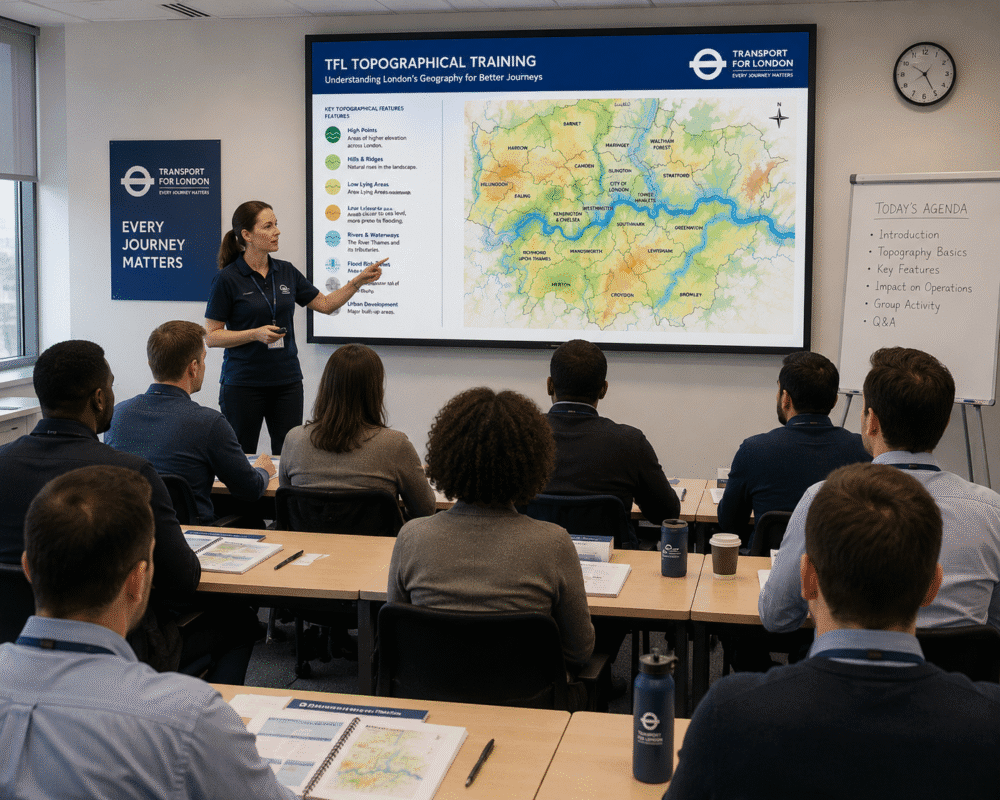
Starting a flexible career as a Private Hire Vehicle (PHV) driver means clearing one major hurdle: the map. While everyday driving relies heavily on GPS apps, licensing demands passing the mandatory Transport for London (TfL) topographical assessment. Industry data reveals that many applicants underestimate this strict legal requirement, mistakenly assuming smartphone navigation equals exam readiness. We provide the Best Topographical Training in East London because we we believe the quality TfL topographical assessment preparation bridges the gap between digital driving and manual route planning, equipping you to conquer your PCO license map reading requirements and accelerate your new career.
Mastering the Four Pillars of the TfL Assessment: What the Computer-Based Test Really Looks Like
Most drivers rely on GPS daily, but the Transport for London (TfL) assessment tests a completely different skill set. While the actual exam is computer-based, success depends entirely on your ability to navigate a physical book. Understanding Master Atlas of Greater London layouts proves you can confidently handle complicated one-way systems and river crossings if your digital screen ever fails.
To pass London PCO map reading test requirements, you must master four specific modules. The official assessment features these distinct challenges:
- Map indexing: Quickly finding specific streets or postcodes using the atlas grid reference system.
- Compass points navigation: Answering directional questions to understand how landmarks sit relative to one another.
- General map reading: Identifying exact locations, stations, and road signs on a static map.
- Route planning: The most heavily weighted section, requiring you to carefully trace the most direct, legal path between two points.
Getting comfortable with these foundational pillars takes guided practice rather than guesswork. Top-tier topographical training saves both time and money, making it highly beneficial to compare top-rated centers in Stratford, Barking, and Ilford to find the ideal learning environment.
Where to Train in East London: Comparing Top-Rated Centers
Finding the right environment is just as crucial as understanding the map itself. We offer excellent options, but your priority should be officially accredited PCO training centers in London. Because this area operates as a major transport hub, these schools typically feature state-of-the-art computer labs, ensuring you learn essential navigation skills in a professional, distraction-free setting.
Just down the road, you will discover several top-rated topographical test centers London drivers consistently recommend. When evaluating these locations, consider whether you thrive in a bustling group class or need dedicated one-to-one sessions. Group classes offer fantastic value and shared insights, while private tutoring guarantees that an experienced instructor focuses entirely on specific weak points.
Another vital feature to verify is the quality of a facility’s practice software, particularly when researching the best PCO school near Ilford. The most reputable providers offer mock topographical exams that perfectly mirror the real Transport for London computer system. Taking these simulated tests removes exam-day anxiety by letting you practice clicking, dragging, and plotting routes digitally before the official assessment.
Always check independent Google reviews and look for high first-time pass rates before booking sessions to ensure your money is well spent. Securing a highly-rated school with authentic practice software is the first step; the next is tackling the most challenging part of the assessment: practical route planning.
The ‘River Crossing’ Strategy: Why Practical Route Planning Practice Beats Online-Only Study
While smartphone apps calculate directions instantly, the TfL assessment forces you to think like a mapmaker. Physical, interactive London route planning exercises build the crucial spatial awareness needed to navigate complex areas without relying on a screen.
Mastering the River Thames is often the biggest hurdle for new candidates. Bridges and tunnels act as strict “gateways” that dictate your entire journey. If you need to travel from Canning Town to Greenwich, for example, the Blackwall Tunnel becomes a mandatory funnel. Quality one-to-one private hire driver training teaches you to identify these gateways first, working backward to plot the most direct path instead of guessing.
Even a perfectly planned path will score zero if you miss the map’s hidden rules. Examiners frequently set map traps to test your attention to detail. Watch out for these common ‘Automatic Fail’ traps during route planning:
- Ignoring one-way street arrows along your path.
- Drawing route lines through solid boundaries, buildings, or green spaces.
- Crossing into roads with restricted or “no entry” turning signs.
Recognizing these hazards takes guided, practical repetition. Ensuring your chosen school provides this level of detail is crucial for avoiding costly re-test fees.
Avoid the Re-test Fee: 3 Questions to Ask Your Training Center Before Paying
Failing the TfL exam doesn’t just delay your new career; it drains your wallet through repeated fees. To find truly affordable PHV driver assessment courses, you must separate professional schools from unreliable tutors. Rigorously vetting a training center before handing over your money is critical for a first-time pass. Protect your investment by asking these three essential questions:
- What is your verified first-time pass rate?
- Are there hidden costs, or is this a complete package?
- Do you use authentic TfL-style map simulation software?
Smart candidates also look for SERU and topographical test bundle deals. The SERU (Safety, Equality and Regulatory Understanding) assessment is another mandatory TfL requirement, and combining this preparation saves significant money compared to booking individual sessions. Verifying a provider’s official accreditation clears the path to building a realistic roadmap for your new career.
Your 30-Day Roadmap to Passing the Topographical Test
The TfL assessment is a manageable stepping stone rather than a barrier. Confidently map out a realistic four-week preparation timeline: spend week one comparing centers and booking your test, dedicate weeks two and three to intensive practice mastering the map reading requirements, and reserve your final week for mock exams.
The duration of topographical training depends heavily on finding the right mentors. By investing in the best topographical training East London offers, navigating complex routes will soon feel natural, empowering you to unlock the flexibility and independence of your new professional driving career.
