

The TfL Topographical Skills Assessment is a mandatory test that every aspiring private hire vehicle (PHV) driver in London must pass before receiving a licence. TfL requires this assessment as proof that you can read an A-Z map, plot accurate routes, and navigate London’s complex road network without relying solely on GPS. The test sits at the heart of the PHV licensing process, and understanding why it exists helps you approach your preparation with the right mindset. Passing it is entirely achievable with focused study and the correct training support.
Why is the topographical test required in London?
The topographical test is compulsory because London’s road network is one of the most complex urban environments in the world. TfL’s licensing policy sets a clear standard: every private hire driver must demonstrate genuine knowledge of streets, landmarks, and routing before carrying a single passenger. That standard exists to protect the public, not simply to create a bureaucratic hurdle.

GPS technology is useful, but it has real limitations in a city like London. Signal loss in tunnels, incorrect map data, and sudden road closures can all cause a GPS system to fail at the worst possible moment. Knowledge-qualified drivers routinely complete journeys faster than GPS-guided routes by reading live traffic flow and road layouts instinctively. That adaptability is exactly what TfL wants to verify.
The key reasons TfL mandates topographical knowledge include:
- Passenger safety. A driver who knows the road network can react calmly to diversions, closures, and incidents without panicking or making dangerous U-turns.
- Service reliability. Passengers booking a PHV expect to reach their destination efficiently. Local knowledge reduces delays caused by GPS rerouting errors.
- Regulatory accountability. TfL holds licensed drivers to a professional standard. The test creates a measurable, consistent benchmark across all applicants.
- Reduced GPS dependency. Topographical knowledge replaces unreliable assumptions with hard data, ensuring driver decisions align with the reality of London’s roads rather than outdated digital maps.
Pro Tip: Treat the topographical test as a professional qualification, not just a box to tick. Drivers who genuinely learn London’s layout report far greater confidence on the road from day one.
What does the topographical test actually assess?
The TfL topographical assessment goes well beyond basic map reading. It evaluates your ability to understand London’s dynamic road network and make quick routing decisions under pressure, simulating real-world conditions including diversions and unexpected changes.
The test covers four core areas:
- Route plotting on an A-Z map. You are given a start point and destination and must plot the most direct, practical route using a standard London A-Z street atlas. Accuracy matters: examiners check your turns, road names, and grid references.
- Landmark and street identification. You must name key streets, junctions, and landmarks along a given route. This includes recognising one-way systems, central reservations, and restricted zones.
- Spatial awareness under pressure. The assessment simulates real-world conditions including diversions and road changes, not just static recall. You need to demonstrate that you can adapt a route mid-journey.
- Speed and decisiveness. Examiners assess how quickly and confidently you arrive at routing decisions. Hesitation or repeated corrections count against you.
The table below summarises what each element of the test measures:
| Test element | What it measures |
|---|---|
| Route plotting | Accuracy of chosen path from A to B on an A-Z map |
| Street and landmark naming | Recall of road names, junctions, and key locations |
| Diversion handling | Ability to reroute quickly when a road is blocked |
| Decision speed | Confidence and pace of routing choices under exam conditions |
One critical rule you must know: you have only two attempts to pass the TfL topographical test. If you fail both, your entire TfL application resets. That two-attempt limit makes thorough preparation non-negotiable.
What are the benefits of mastering London’s topography?
Passing the test is the immediate goal, but the knowledge you build has lasting professional value. Drivers with strong topographical skills deliver faster, more reliable journeys. They handle disruptions calmly, build passenger trust, and earn better ratings on booking platforms.
“A driver who truly knows London is not just following a route. They are reading the city in real time, anticipating problems before they appear on any screen.”
The cognitive benefits are equally significant. Memorising London’s 25,000 streets and over 100,000 landmarks produces measurable changes in spatial-processing capability. Neuroscientific research shows that this level of geographical memorisation builds cognitive reserve, which may delay the onset of spatial disorientation conditions including Alzheimer’s disease. The learning process itself makes you sharper.
The professional advantages extend further:
- Faster journey times. You choose the best route immediately rather than waiting for GPS recalculation.
- Stronger passenger relationships. Passengers notice when a driver knows exactly where they are going. That confidence builds repeat bookings.
- Career resilience. Technology changes. Your knowledge does not. Drivers with deep local expertise remain valuable regardless of which app or platform they work through.
- Competitive edge. In a crowded PHV market, local knowledge differentiates you from drivers who depend entirely on navigation apps.
How should you prepare for the TfL topographical test?
Effective preparation combines structured study with realistic practice under exam conditions. The most successful candidates treat preparation as a phased programme rather than a last-minute revision session.
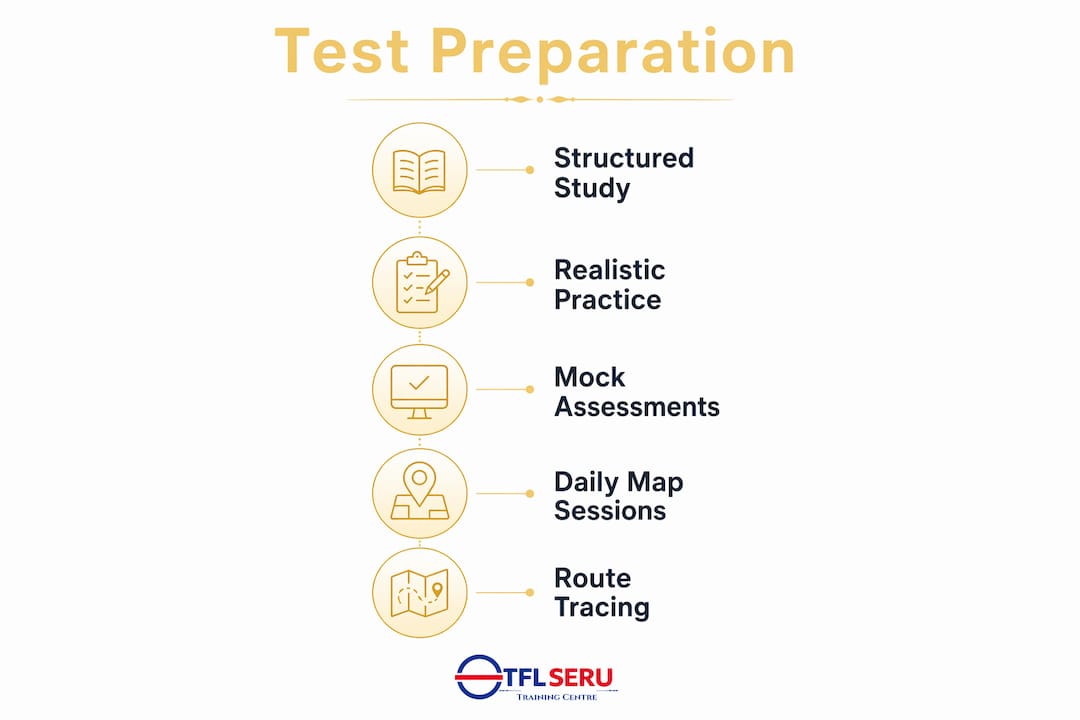
Specialised training centres like Eltconline, based in Forest Gate, London E7, offer courses built specifically around TfL assessment requirements. Eltconline’s instructors have extensive expertise with the topographical assessment format and have helped thousands of candidates pass with confidence. That depth of experience matters when you only have two attempts.
The table below compares the two main preparation approaches:
| Preparation method | Strengths | Best suited for |
|---|---|---|
| Self-study with A-Z maps | Low cost, flexible timing | Candidates with strong map-reading foundations |
| Structured training centre course | Expert guidance, mock tests, feedback | Candidates who want to maximise their pass rate |
Mock tests are the single most effective preparation tool. They replicate the pressure of the real assessment and reveal exactly which areas need more work before you sit the official test. Eltconline’s mock tests are aligned with current TfL requirements, so you practise the right material in the right format.
Alongside mock tests, proven study techniques include daily A-Z map sessions, tracing routes from memory, and practising grid reference lookups against a timer. Breaking London into zones and mastering one zone per week makes the volume of information manageable.
Pro Tip: Practise plotting routes without looking at the map first. Write down the roads you think connect two points, then check your answer against the A-Z. This active recall method builds memory far faster than passive reading.
Key takeaways
The TfL topographical test is a mandatory licensing requirement that protects passengers, enforces professional standards, and builds the navigational expertise every London PHV driver needs to work safely and effectively.
| Point | Details |
|---|---|
| Mandatory TfL requirement | Every PHV applicant must pass the topographical test before receiving a licence. |
| Two-attempt limit | Failing both attempts resets your entire TfL application, making preparation critical. |
| Beyond GPS reliance | Manual topographical knowledge enables faster, safer routing when technology fails. |
| Cognitive and career benefits | Memorising London’s streets builds spatial intelligence and long-term professional value. |
| Structured training works | Mock tests and specialist courses from centres like Eltconline significantly improve pass rates. |
Why I believe the topographical test is more relevant in 2026 than ever
I have worked with hundreds of aspiring PHV drivers over the years, and the candidates who struggle most are those who underestimate the test because they assume GPS makes it redundant. That assumption is wrong, and it costs people their applications.
London’s road network changes constantly. New cycle lanes, Low Traffic Neighbourhoods, and event closures appear with little warning. A driver who relies entirely on a navigation app is always one software glitch or signal drop away from a problem. The driver who knows the city instinctively is never in that position.
What I find most compelling is the long-term career argument. Drivers who invest properly in topographical knowledge report higher passenger satisfaction, fewer complaints, and greater earning consistency. The test is not a barrier. It is a foundation. The candidates who treat it that way, and who commit to genuine learning rather than hoping to scrape through, are the ones who build lasting careers in this industry.
If you are preparing now, do not cut corners on study time. Map out a rigorous plan, use mock tests regularly, and seek expert guidance. The two-attempt limit is real, and the cost of restarting your application is far greater than the cost of proper preparation.
— East
Eltconline: specialist training for your TfL topographical test
Eltconline is an approved TfL Topographical Assessment training centre based in Forest Gate, London E7. The centre’s experienced instructors have guided thousands of candidates through successful assessments, and every course is built around the current TfL test format.
Whether you are starting from scratch or looking to sharpen your skills before your assessment date, Eltconline offers topographical training courses and TfL mock tests that replicate real exam conditions. With only two attempts available, the right preparation is not optional. You can also explore training packages designed to cover every aspect of the assessment in a structured, manageable programme. Give yourself the best possible chance of passing first time.
FAQ
What is the TfL topographical test?
The TfL Topographical Skills Assessment is a mandatory test for private hire driver licence applicants in London. It evaluates map-reading ability, route plotting, and knowledge of London’s streets and landmarks using an A-Z atlas.
Why does TfL require topographical knowledge?
TfL mandates topographical knowledge to ensure every licensed PHV driver can navigate London safely and efficiently, particularly when GPS systems fail or road conditions change unexpectedly.
How many attempts do you get at the topographical test?
You have two attempts to pass the TfL topographical test. Failing both means your TfL application resets entirely, so thorough preparation before your first attempt is strongly advised.
Does GPS replace the need for topographical knowledge?
GPS does not replace topographical knowledge. Signal loss, outdated map data, and sudden road closures all limit GPS reliability. Drivers with genuine local knowledge adapt faster and deliver more reliable journeys than those who depend solely on navigation apps.
How can Eltconline help me prepare for the test?
Eltconline provides specialist PHV topographical training and mock tests aligned with current TfL requirements. The centre’s instructors have extensive experience with the assessment format and have helped thousands of candidates pass with confidence.
Recommended
- Topographical test booking process: 2026 guide
- What is the TfL Topographical Test? 2026 guide
- What is topographical knowledge assessment for TfL drivers
- Topographical test study techniques: 2026 guide
