

Topographical training before a PCO application is the mandatory preparation that equips you to pass the TfL Topographical Skills Assessment before Transport for London will accept your private hire vehicle (PHV) licence application. The assessment tests your ability to read a London A–Z street map, locate places, and plan routes of varying length and complexity under timed conditions. Without a pass certificate, your PCO application cannot proceed. Completing structured training first is not optional. It is the single most effective way to protect your two permitted attempts and keep your licensing journey on track.
What does topographical training before PCO application involve?
Candidates must pass the Topographical Skills Assessment before completing their PCO licence application. This is an official TfL requirement, not a recommendation. The assessment is computer-based and tests practical map-reading skills using the London A–Z format. You will not be asked to memorise street names. You will be asked to locate places, identify grid references, and plan routes across London’s road network within a set time.
The test covers routes of differing length and complexity to simulate real driving scenarios. A short route might ask you to travel between two nearby postcodes in East London. A longer route could require you to plan a journey from Heathrow to the City, identifying key roads and junctions along the way. The assessment tests map reading and route planning using London A–Z street mapping specifically. This is distinct from the full Knowledge of London required for black cab drivers, but it demands genuine spatial awareness and confidence with printed maps.

The test is taken at an approved centre. The Topographical Skills Assessment fee increased to £40 for a first attempt and £30 for resits as of march 2026. That cost matters because you only have two attempts before your entire TfL application must restart. Understanding what the test involves is the first step toward preparing for it properly.
Key components tested in the assessment
- Map orientation: Reading the London A–Z correctly, including understanding the grid reference system.
- Place location: Finding named streets, landmarks, and postcodes within the map index.
- Route planning: Identifying a logical, practical route between two points, including noting one-way streets and central reservations.
- Computer navigation: Basic mouse and screen skills to interact with the digital test interface.
- Time management: Completing all questions within the allotted time without rushing into errors.
Which training methods best prepare you for the topographical test?
Revision using London A–Z maps significantly increases your chance of passing on the first attempt. The map format used in the test is specific. Practising with the actual A–Z, rather than a generic road atlas or a digital navigation app, builds the visual familiarity you need on test day. The following methods, used in combination, produce the strongest results.
-
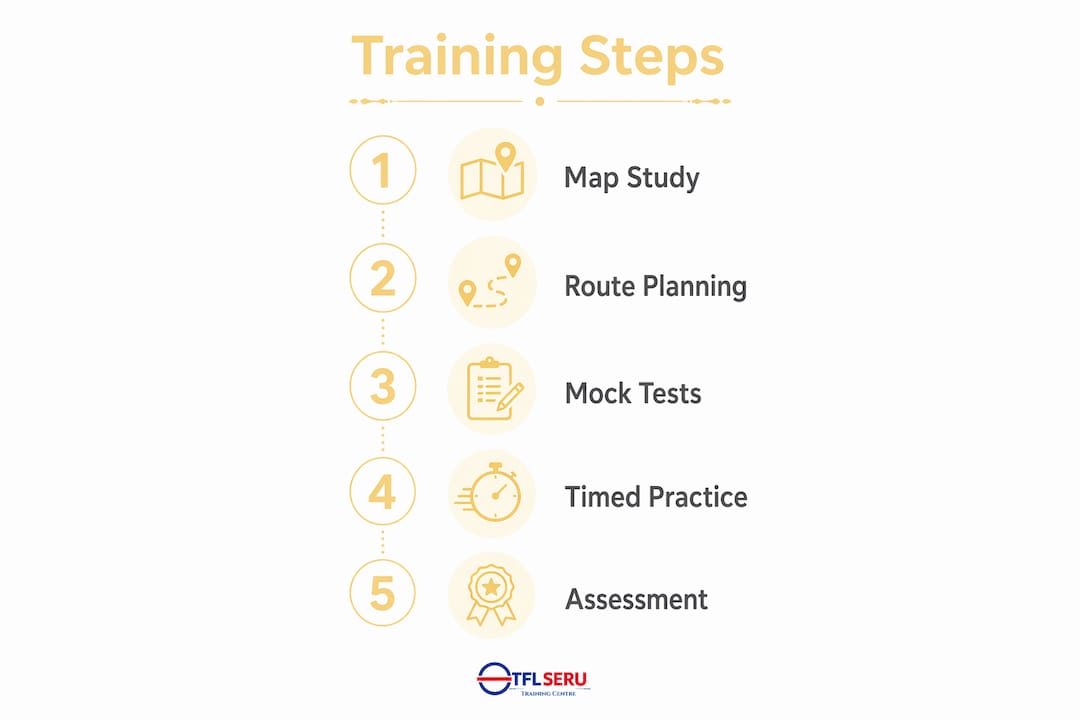
Daily A–Z map drills. Set aside 20–30 minutes each day to locate streets, identify grid references, and trace routes by hand. Start with areas you know well, then move to unfamiliar parts of London. This builds confidence progressively.
-
Timed route-planning exercises. Repeated practice under time constraints builds accuracy and reduces test anxiety. Set a timer and complete a full route plan from start to finish. Review your answer, identify errors, and repeat.
-
Structured training courses. Attending a dedicated course, whether in person or online, gives you access to professional guidance and structured content. TfL SERU learning materials and mock tests at specialist centres such as Eltconline improve preparedness and confidence measurably.
-
Mock tests. Sitting a full mock test under realistic conditions is the closest preparation to the real assessment. It reveals gaps in your knowledge and helps you manage time pressure. Eltconline offers topographical mock tests designed to replicate the TfL format precisely.
-
App verification, not app reliance. Use Google Maps or Waze to verify a route after you have planned it on the A–Z. This reinforces spatial awareness without creating dependency on turn-by-turn navigation.
-
Study group practice. Working with other candidates allows you to quiz each other on grid references and street locations. Explaining a route to someone else deepens your own understanding.
Pro Tip: After completing a timed route-planning drill on the A–Z, cross-check your route on a digital map. Note any roads you missed or misread. This combined approach builds both accuracy and spatial confidence faster than either method alone.
The topographical test study techniques guide for 2026 from Eltconline provides additional structured exercises and worked examples to supplement your practice.
When should you schedule topographical training relative to your PCO application?
Candidates should schedule and complete topographical training before other licensing milestones that depend on test clearance. This is the single most common mistake made by new applicants. Many candidates begin gathering their medical certificates, DBS checks, and vehicle documents before booking their topographical training. When the test then takes longer than expected, the entire application stalls.
The correct sequence is straightforward. Book your training course first. Complete your practice. Sit the assessment. Then submit your PCO application with your pass certificate in hand. Completing training and the assessment first prevents process bottlenecks that can cost weeks of delay.
Common scheduling pitfalls to avoid
- Leaving training until the last minute. Cramming for a map-reading test rarely works. Spatial skills develop through repetition over days and weeks, not overnight.
- Booking the test before you are ready. With only two attempts available, sitting the assessment before completing adequate preparation wastes a valuable attempt.
- Ignoring test centre availability. Popular test slots fill up quickly. Book your assessment date early so your training timeline aligns with your chosen sitting.
- Treating the test as an afterthought. Some candidates focus heavily on the SERU assessment and vehicle requirements, then underestimate the topographical component. Both require dedicated preparation.
- Failing to track progress. Set weekly milestones: grid reference accuracy, route completion speed, and unfamiliar area coverage. Tracking progress keeps motivation high and reveals where more practice is needed.
Pro Tip: Map out a study plan that works backwards from your intended test date. Allow at least three to four weeks of daily practice before sitting the assessment. This gives you time to identify weak areas and address them without pressure.
Early and strategic study of topographical skills alongside other licensing steps aids smoother application progress. Candidates who treat the topographical assessment as their first milestone consistently report a less stressful overall application process.
What are the most common mistakes in topographical test preparation?
Most candidates who fail the assessment make the same identifiable errors. Recognising these mistakes before you begin training saves you time, money, and a wasted attempt.
-
Relying on smartphone navigation apps. Using A–Z maps as the primary training tool is essential. Apps should only verify routes, not replace map-based practice. The test does not allow digital navigation. Candidates who train exclusively on apps arrive at the test centre unable to read a printed map under pressure.
-
Underestimating time pressure. The assessment is timed. Candidates who practise without a clock often find the real test far harder than expected. Every practice session should include a timer from the start.
-
Skipping mock tests. A mock test is not a luxury. It is the most accurate predictor of your readiness. Sitting at least one full mock test before your real assessment date is a minimum standard, not an optional extra.
-
Ignoring test centre requirements. Check what identification and documentation you need to bring on test day. Arriving without the correct paperwork can result in being turned away, which counts as a failed attempt.
-
Practising only familiar areas of London. The test covers the whole of Greater London. Candidates who focus only on their home borough are regularly caught out by questions covering West London, South London, or the outer zones.
-
Cramming the night before. Spatial memory consolidates during sleep. A long cramming session the night before the test is less effective than a short review followed by a good night’s rest.
The topographical knowledge assessment guide for TfL drivers from Eltconline explains the test format in detail and helps candidates avoid these preparation errors from the outset.
Key takeaways
Completing structured topographical training before your PCO application is the most reliable way to pass the TfL Topographical Skills Assessment on your first attempt and avoid costly delays to your licence.
| Point | Details |
|---|---|
| Assessment is a pre-application requirement | You must pass the TfL Topographical Skills Assessment before TfL will accept your PCO application. |
| A–Z map practice is non-negotiable | Train with the London A–Z daily. Apps cannot replace printed map skills for this test. |
| Schedule training first | Book your course before gathering other application documents to prevent delays. |
| Mock tests predict readiness | Sit at least one full mock test under timed conditions before your real assessment date. |
| Two attempts only | You have just two chances at the assessment. Structured preparation protects both attempts. |
Why I think most candidates underestimate this test
Candidates consistently arrive at the topographical assessment assuming it will be straightforward. They have lived in London for years. They drive every day. They use Google Maps without a second thought. None of that prepares you for reading a printed A–Z under time pressure and plotting a route across a city of nine million people.
The candidates I have seen succeed are not the ones with the best sense of direction. They are the ones who treated preparation as a skill-building process. They practised daily, sat mock tests, and tracked their progress honestly. They did not cram. They built the skill gradually, the same way you would learn any practical ability.
The two-attempt rule changes everything. When you know that a second failure restarts your entire TfL application, the stakes feel very different. That pressure is real, and it is why professional guidance matters. Candidates who train with structured support, including mock tests and expert feedback, pass at a significantly higher rate than those who prepare alone.
My advice is simple. Start early. Use the A–Z. Sit a mock test before you book the real one. And do not let familiarity with London fool you into thinking you do not need to prepare. The test measures a specific skill. That skill is trainable. Give yourself the time to train it properly.
— East
Eltconline’s topographical training for your PCO application
Eltconline is a TfL-approved topographical training centre based in Forest Gate, London E7, with a strong record of helping candidates pass the assessment confidently.
Eltconline offers structured training packages covering classroom sessions, online learning, and full TfL topographical mock tests that replicate the real assessment format. Whether you prefer in-person tuition or the flexibility of home study, Eltconline’s experienced tutors guide you through every component of the test. Thousands of candidates have passed their topographical assessment with Eltconline’s support. If you are preparing for your PCO licence application, Eltconline’s training programme gives you the skills and confidence to pass first time.
FAQ
Do I need to pass the topographical test before applying for a PCO licence?
Yes. The TfL Topographical Skills Assessment is a mandatory pre-application requirement. You must hold a pass certificate before Transport for London will process your PCO licence application.
How many attempts do I get at the TfL Topographical Skills Assessment?
You get two attempts. Failing both means your entire TfL application must restart from the beginning, which is why thorough preparation before your first sitting is critical.
What is the best way to prepare for the topographical test?
Daily practice with the London A–Z map, timed route-planning exercises, and at least one full mock test are the most effective preparation methods. Structured courses at specialist centres such as Eltconline provide professional guidance alongside these methods.
How much does the TfL Topographical Skills Assessment cost in 2026?
The fee is £40 for a first attempt and £30 for a resit, following a price increase that came into effect in march 2026.
Can I use a smartphone or GPS app during the topographical test?
No. The test is map-based and does not permit digital navigation tools. Training with the London A–Z printed map is the only reliable way to build the skills the assessment requires.
Recommended
- Topographical Test Training | Get quality training | ELTC
- PCO application timeline explained: 2026 guide
- London PCO Licence Application
- PCO Training in London | TFL Topographical & SERU Training
